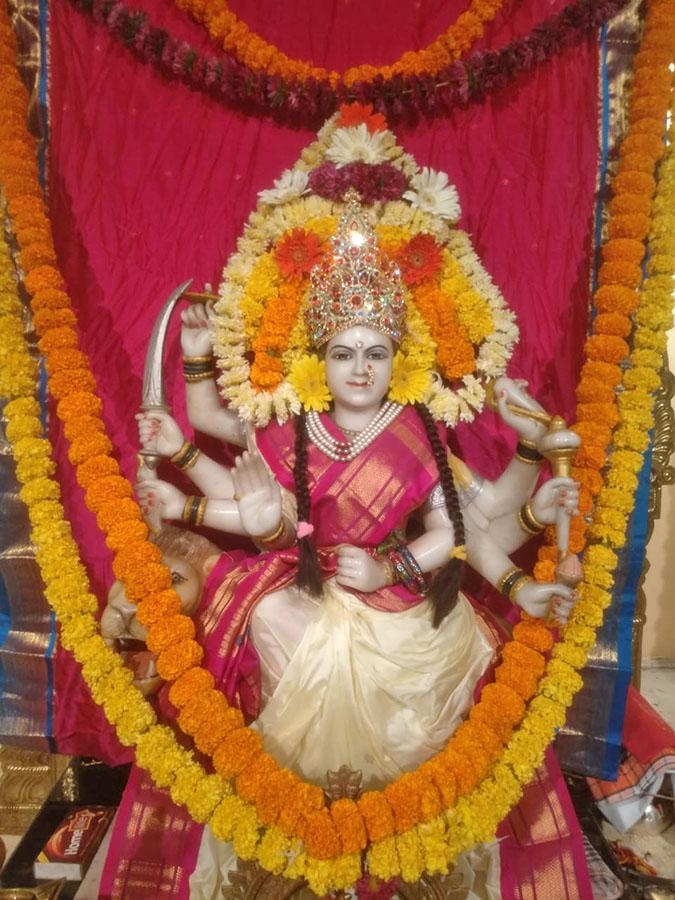
SALUTATIONS TO MOTHER DURGAA.
Today 7th October 2021 is the auspicious beginning of Navaratra festival and I propose to start a series on Kumkumaarchana and similar modes of Devi worship. Today is GhaTa (घट) Sthaapana (स्थापना) consecration of the Vessel (कलश), thus heralding the advent of Divine Mother. Symbolically its message is that we have to invoke Divine Mother within us, enshrine Her (स्थापना) within the pitcher (घट) that is our body (घट घट वासीरे as the bhajan says). All our festivals are thus रूपक-s, figuratively camouflaged spiritual truths.
KUMKUMAARCHANA
This is a very popular and easy mode of adoring Devi. Kumkum is dear to Her. Sindhur, HaLdi (turmeric), collyrium (kaajjaL) and Kumkum are called ‘auspicious material’ (सौभाग्य द्रव्य) and we offer them to
Devi during Devi Poojan saying: भक्त्यर्पितानि श्रीमातः सौभाग्यानि च स्वीकुरु।(Pray accept theseloving offerings, O Holy Mother).
In our Shankara NaaraayaNa Geetam, in verse no. 5, we describe both Paarvati and
Shankara thus:
कुङ्कुमांकित पार्वती तनु कुङ्कुमार्द्रशरीर भो.
Paarvati has applied Kumkum on Her body liberally and because Shiva is
inseparably one with Her, His body(तनु) has also become moist(आर्द्र) with Kumkum.
Not only Paarvati, but Lakshmi, too, is very fond of Kumkum. The popular Kannada bhajan Bhaagyada Lakshmi Baaramma ( see Stutimanjari, bhajan section) refers to Her in stanza two, as कुङ्कुमाङ्किते पङ्कज लोचने (lotus-eyed, Kumkuma applied).
Thus, Kumkuma looms all over in Her praises and hence its choice as an easy way of propitiating Devi in Kumkumarchan.
We have seen Bhatmams chanting ॐ ह्रीं दुं दुर्गायै नमः 108 times, each time making the participants offer a pinch of Kumkum on a plate with Mriga-Mudraa (not using the fore finger and little finger, the rest form a bunch). The above chant is a मूल मन्त्र and preferably should be chanted by those who have been initiated into it by the Guru.
For the rest it is preferable to chant the 108 Names of Devi as we do in Devi Poojan. During Durgaashtami we can chant Durga AshTottara and on Lalita Panchami, Lalita Ashtottara or Trishati and do Kumkumarchan. On other days, any Devi Ashtottara can be chanted. Leaving aside the Navaratra period, during rest of the year, Tuesdays and Fridays are preferable for this sevaa.
Kumkum once used should not be recycled for Kumkumaarchan again. It can be used for Haldi-Kumkum get-to-gethers.
Aachamana, PraaNaayaama, Sankalpa and Dhyaana should be done before doing Kumkumaarchan. During Sankalpa we should say:
श्री दुर्गापरमेश्वरी प्रसाद सिद्ध्यर्थे कुङ्कुमार्चनं करिष्ये (श्री ललिताम्बा….). ध्यान श्लोक
can be taken from Devi-poojan section in
Stutimanjari. We should conclude
Kumkumarchan by saying:
अनेन कृतेन कुङ्कुमार्चनेन श्री दुर्गपरमेश्वरी प्रीयतां, सुप्रीता वरदा भवतु(श्री ललिताम्बा….).
I am grateful to our venerable Vaidiks at Shirali for their valuable guidance.
Attached is an audio of the bhajan कुङ्कुम वाहिले प्रेमे आई sung by Chitrapur Bhajana Mandali and Shiva-Shakti Bhajana Mandali, Bengaluru (Courtesy: Anupama Chandavar,Bengaluru).
V.RAJAGOPAL BHAT
7th October, 2021
DURGAA NAMASKAAR
There is a wellknown saying that in Kali Yuga it is more rewarding and meritorious to worship Durgaa and Ganesha(कलौ दुर्गा विनायकौ). कलि युग is notorious for obstacles and hardships of unimaginable variety. Hence the urgent need for trouble-shooters like Ganesha and Durgaa. The former shoots down all types of obstacles(विघ्न) while the latter battles all that is negative within us and without, thereby making दुर्गम life turn into सुगम. Yesterday, I wrote about Kumkumaarchan.. Today I will write about another popular Devi अनुष्ठान called Durgaa Namaskaar. In the south it is also called दुर्गा दीप नमस्कार।
Most of us have witnessed this beautiful पूजा either at Karla, SCM Shirali, SCM Bengaluru or at home. A Divli is florally decorated and is placed on a ManDala drawn colourfully on the floor. Sometimes flower petals are also strewn around the Divli. The MaNDala symbolises the whole colourful universe which is pervaded by Devi(अखण्डमण्डलाकारं यया व्याप्तं चराचरम्).. The five wicks (वाति in KonkaNi) in the Divli represent the five faces(आस्य) of Durgaa(पञ्चास्यां रक्तवर्णाम्). Devi is proficient in five functions(पञ्च कृत्य परायणा)
(a name in Lalitaa Sahasranaama). The five
wicks symbolise these five functions of
सृष्टि स्थिति लय निग्रह and अनुग्रह. When we say Pancha-durgaa or Navadurgaa, we should go beyond the pictorial imagery and grasp the symbolism. Devi is One Shakti and each of Her aspects is called Durgaa. The plurality(बहुवचन) is functional(कार्य) – कार्य बाहुल्य, not वस्तु बाहुल्य. If this important point is overlooked, we lay Hinduism open to the charge of Polytheism.
The Deepa(divli) is placed by chanting the मूल मन्त्र Aum hreem dum दुर्गायै नमः(इति मूलेन
दीपं प्रतिष्ठापयेत्). Then the five wicks are lighted – east onwards- by chanting the five mantraa-s from Durgaa Sookta(ततः पञ्चवर्ती:
पञ्चमन्त्रैः पूर्वादिक्रमेण प्रज्वालयेत्). I will elucidate Durgaa Sookta in due course.
I am attaching a couple of photos of the Deepa(divli) taken at SCM, Bengaluru during DN made available to me by Smt.
Anupama Chandavar, Bengaluru.


DURGAA NAMASKAAR(contd)
A striking feature of दुर्गानमस्कार is the मातृका न्यास to propitiate Sarasvati, the Goddess of Learning and the Mother of Alphabets(मातृका). Look at the way the
consonants(व्यञ्जन) are tucked skillfully in between the vowels(स्वर):
Aum अंकंखंगंघंङ्आं अङ्गुष्ठाभ्यां हृदयाय नमः
Aum इंचंछंजंझंञंईं तर्जनीभ्याम् शिरसे स्वाहा
Aum उंटंठंडंढंणंऊं मध्यमाभ्यां शिखायै वषट्
Aum एंतंथंदंधंनंऐं अनामिकाभ्याम् कवचाय हुम्
Aum ओंपंफंबंभंमंऔं कनिष्टिकाभ्यां नेत्र त्रयाय वौषट्
Aum अंयंरंलंवंशंषंसंहंळंक्षंअ: करतलकरपृष्ठाभ्यां नम:
अस्त्राय फट्।।
Adoring the alphabets with religious fervour is one of the unique features of
Hinduism. The above न्यास is a mighty tongue-twister, but, our venerable Vaidiks
reel them out in a rapid fire mode and make you gape in wonder at their expertise. To music lovers, they remind of तराना maestros!
In अन्नपूर्णा स्तोत्रम् Devi is hailed by आचार्य शङ्कर
as: आदि क्षान्त समस्त वर्णन करी(She is the designer of all the alphabets from अ to क्ष).
The officiating Bhatmaam chants the moola
mantra(ॐ ह्रीं दुं दुर्गायै नमः) and guides the
यजमान to offer, if he has the strength and the stamina, at least 54 पञ्चाङ्ग नमस्कार by chanting ‘Aum I offer myself in utter surrender to Devi Durgaa'(ॐ दुर्गा देवीं शरणम् अहं प्रपद्ये). During नवरात्र DN can be performed on all days. During rest of the year, Fridays, AshTami and PoorNimaa are the choice.
I am not giving other details like सङ्कल्प etc
since an officiating Bhatmaam is ‘a must’
and one may not be competent to do DN all
by himself by reciting Durgaa Sookta with proper Vedic intonation.
I will explain the Durgaa Sookta tomorrow.
ATTACHMENT: A SMALL BHAJAN CLIP OF
P.P.SHRIMAT SADYOJAT SHANKARASHRAM
SWAMIJI – Please see the ‘Prasaad’ slipping
down.
SHREE DURGAA SOOKTAM
This text is an important ingredient in Devi
worship. It is found in the Taittiriya AraNyaka(4-10-2). It also occurs in Mahaa-NaaraayaNopanishad(Anuvaaka 2,
Mantraas 1 to 7.
This Sookta adores both the sacrificial fire
and Devi Durgaa. They are equated with
each other. Fire purifies by getting rid of the dross of gold etc. So does Devi. She is fiery
and in the Dhyaana Shloka we refer to Her as ANALAATMIKAA(अनलात्मिकां शशिधरां दुर्गां
त्रिनेत्रां भजे). अनल means fire.
Now we will study Durgaa Sookta:
ॐ जातवेदसे सुनवाम सोमम् अरातीयतो निदहाति वेदः।
स नः पर्षदति दुर्गाणि विश्वा नावेव सिन्धुं दुरितात्यग्निः।।१।।
Aum जातवेदसे to the All-Knowing Agni सुनवाम
may we press out (the Soma creeper) for
oblation वेदः knowledge, Agni who is the
repository of knowledge अरातीयतः those who
are hostile to us निदहाति may reduce to ash
सः he नावा by a boat सिन्धुं ocean इव like नः us
विश्वा all दुर्गाणि obstacles अति beyond पर्षत्
may protect दुरिता errors of omission and
commission.
“May we offer oblations of Soma to the All-Knowing Agni. May He, the Know-All, destroy what is inimical to us. May He
protect us by taking us across all obstacles and crises like a boatman across the sea.
May He also save us from all wrong-doing.”
Agni refers explicitly(वाच्यार्थ) to Fire, but,
implicitly(लक्ष्यार्थ) to the Supreme God or
Goddess. The word Agni is derived by
commentators like SaayaNa as अग्रं नयति
अग्रणिः अग्निः – He/She who leads us forward
(to our goal of Self-Realisation).
ATTACHMENT -SHREE DURGA SOOKTAM
SHREE DURGAA SOOKTAM (CONTD)
ताम् अग्निवर्णां तपसा ज्वलन्तीं वैरोचनीं कर्मफलेषु जुष्टाम्।
दुर्गां देवीं शरणमहं प्रपद्ये सुतरसि तरसे नमः।।२।।
अग्निवर्णाम् fiery in lustre तपसा ज्वलन्तीं radiant
with tapas(penance) वैरोचनीं being the power
(shakti) of Him who manifests Himself in
various(वि) pleasing(रोचन) names and forms
कर्मफलेषु जुष्टाम् engaged (जुष्टाम्) in distributing results (फलम्) to souls according to the merits of their actions(कर्म) ताम् Her दुर्गा
देवीम् Goddess Durgaa अहम् I शरणं प्रपद्ये
surrender तरसे O Thou adept in ferrying us across सु तरसि Pray safely ferry us across ते नमः salutations to Thee.
“My utter surrender to Devi Durgaa, glowing with fiery radiance and blazing with तपस्.
She is the creative power of God, the craftsman of this variegated manifold of
names and forms. She is busy disbursing the fruits of Karma to the souls. She is an
adept in ferrying us across the sea of
troubles. O Thou so adept, pray ferry us across. Our salutations to Thee!”.
In this mantra there is an explicit reference to Devi Durgaa. Durgaa means the redeeming power of God, His Grace, which enables us to tide over obstacles(दुर्ग) and crises(दुर्गायै दुर्गपारायै as stated in अपराजिता स्तोत्र). The word is also derived as ‘ difficult to be understood’ (दु:खेन गन्तुम् अवगन्तुं शक्या). We can’t venture to map out Her magnificence by our feeble intellect.
We can feel Her with our loving heart. We
should not try to probe Her intellectually,
as it will be foolhardy. None ‘understands ‘ a mother better than her child in the cradle, but, the route the child wisely takes is via the heart, and not the head. The sacred books untiringly blare out that the Divine is beyond our senses, speech, mind and intellect:
नायमात्मा बलाहीनेन लभ्यः न मेधया न बहुना श्रुतेन।
नैषा तर्केण मतिरापनीया।
यतो वाचो निवर्तन्ते अप्राप्य मनसा सह।
यो बुद्धेः परतस्तु सः।
But, be it noted, the heart does not figure in
this list at all.
He(अयम्) is in the heart(हृदि), so the heart is
called ‘hridayam’, says Chaandogya Upanishad(VIII-3-3).
Bhajan by P.P. Shrimat Sadyojat
Shankarashram Swamiji
(“दुर्गति तारिणि दुर्गा जय जय”).
दुर्गति तारिणि दुर्गा जय जय by P.P. Shrimat Sadyojat Shankarashram Swamiji
SHREE DURGAA SOOKTAM(CONTD)
अग्ने त्वं पारया नव्यो अस्मान् स्वस्तिभिः अतिदुर्गाणि विश्वा।
पूश्च पृथ्वी बहुला न उर्वी भवा तोकायतनयाय शं योः।।३।।
अग्ने O Agni-Devataa(Durgaa), नव्यो worthy of praise अस्मान् us स्वस्तिभिः with allround
welfare विश्वा all दुर्गाणि obstacles अति beyond
पारया (पारय) take us across. नः our पूः town
पृथ्वी earth बहुला abound in riches उर्वी fertile
भवा (भव) be तोकाय grandchildren तनयाय
children शं योः bringer, joiner(योः) of happiness(शम्).
“O Agni-devataa Durgaa, worthy of our praise, pray bless us with allround welfare
and make us tide over all sorts of obstacles.
May our town, may the entire land, abound in natural wealth. May the earth be fertile.
May our children and grand-children be
showered with happiness”
Swami Vimalananda of RKMission says in his translation of महानारायणोपनिषद् that
though तोकाय and तनयाय are in singular, we have to take them as generic plural. These
two words are also interpreted differently by some. Swami Vimalananda says that SaayaNa, the celebrated commentator of
Vedaa-s, takes तनय as daughter. The long
and short of the prayer(तोकायतनयाय शं योः) is the welfare of the progeny.
ATTACHMENT: Bhajan by P.P.Shrimat
Sadyojat Shankarashram Swamiji(पूर्ण कलामयि संवित् स्वरूपिणि..)
पूर्ण कलामयि संवित् स्वरूपिणि by P.P.Shrimat Sadyojat Shankarashram Swamiji
SHREE DURGAA SOOKTAM(CONTD)
विश्वानि नो दुर्गहा जातवेदः सिन्धुं न नावा दुरितातिपर्षि।
अग्ने अत्रिवन्मनसा गृणानो अस्माकं बोध्यविता तनूनाम्।।४।।
हे जातवेद O All-Knowing Agni Devataa(Durgaa), दुर्गहा eliminator of obstacles विश्वानि universal दुरिता (दुरितानि) evils, sins नावा by a boat सिन्धुं न(इव) like an ocean
अतिपर्षि take us beyond and protect अग्ने O Agni-Devataa अत्रिवत् like Atri, the sage
मनसा mentally गृणानो repeating अस्माकं our
तनूनाम् bodies अविता protector बोधि be mindful
O All-Knower Agni Devataa, You are the eliminator of all obstacles and universal
evils. Pray take us beyond these hurdles just as a boatman ferries us across the ocean. Be mindful of our bodies and their safety like the sage Atri who was always repeating mentally (a prayer for universal welfare).
Atri was probably repeating mentally prayers like ours in सभा समाप्ति प्रार्थना – सर्वे
भवन्तु सुखिनः……।
Swami Vimalananda of RKMission in his
translation of महानारायणोपनिषद् says as follows about Atri:
“There was a great sage who had attained supreme illumination and freedom-in-life
and so was known as Atri: one who is free
from triple miseries(अ-त्रि). Goodwill and
compassion for all created beings constitute the chief character trait of such
a sage. Therefore, people had always observed Atri in a state of mind in which he was constantly remembering in his prayers peace and safety for all creatures.
HE BECAME A BYWORD FOR UNIVERSAL
COMPASSION'(Capitals mine).
No wonder, his wife was free from malice
and fault-finding(अनसूया, no असूया) and they became ideal parents of Shri Dattaatreya.
ATTACHMENT: A Bhajan by P.P.Shrimat
Sadyojat Shankarashram Swamiji (सन्ततमन्तर
भज त्रिपुरांबाम्…).
सन्ततमन्तर भज त्रिपुरांबाम्…by P.P.Shrimat Sadyojat Shankarashram Swamiji
SHREE DURGAA SOOKTAM (CONTD)
पृतानाजितं सहमानम् उग्रम् अग्निं हुवेम परमात् सधस्तात्।
स नः पर्षदति दुर्गाणि विश्वा क्षामद्देवो अति दुरितात्यग्निः।।५।।
परमात् सधस्तात् from a lofty spiritual frame of mind पृतनाजितम् who defeats the enemies सहमानम् of great endurance उग्रम् fierce अग्निम् Agni-devataa हुवेम we invoke सः He देवः God अग्निः विश्वा all दुर्गाणि obstacles, crises अति beyond क्षामत् perishable अति beyond दुरिता (दुरितानि) evils, sins अति beyond नः us पर्षत् may protect.
“Being in a very devout frame of mind, we
invoke Agni-devataa(Durgaa), who defeats
hostile forces, who is full of endurance and is fierce (to the sinful). May He/She make us tide over all obstacles and crises. May He/She lead us from the perishable world of names and forms to the Imperishable state of Liberation and protect us.”
As the readers may have noted, the recurring refrain in almost every mantra is a prayer for making us tide over all sorts of obstacles(durga).. The simile of a boatman and his boat also comes up again and again. Hence the choice of this Sookta in Devi worship. Her very name Durgaa means
the remover of obstacles (दुर्ग) and consequent degradation (दुर्गतिं).
(CONTD) V.RAJAGOPAL BHAT 14-10-2021
ATTACHMENT: A Bhajan by P.P.Shrimat
Sadyojat Shankarashram Swamiji(नवरात्रि श्री
जगदम्बा….)
अम्बा तू अधर देवि अर्बुदा…. by P.P.Shrimat Sadyojat Shankarashram Swamiji
SHREE DURGAA SOOKTAM(CONTD)
प्रत्नोषि कमीड्यो अध्वरेषु सनाच्च होता नव्यश्च सत्सि।
स्वां चाग्ने तनुवं पिप्रयस्वास्मभ्यं च सौभगमायजस्व।।६।।
अध्वरेषु in the sacrifices ईडय: praised in hymns प्रतनोषि you spread out, increase
कम् happiness सनात् च ancient नव्यश्च new, modern होता sacrificer सत्सि (सीदसि) Thou
dwellest अग्ने O Agni-devatas, स्वां तनुवं(तनुं)
पिप्रयस्व be delighted अस्मभ्यं for us सौभगम् good fortune आयजस्व pray bestow च and
“O Agni-devataa, praised and adored in
worship like sacrifices,Thou increasest our
happiness. Thy presence is there in all
worshippers, be they ancient or modern.
O Agni-devataa, be delighted by our worship and pray bestow on us all good
and auspicious fortune.”
These mantraas are used both for worshipping fire and Devi Durga who is fiery
by nature.
(CONTD) V.RAJAGOPAL BHAT 15-10-2021
ATTACHMENT: Bhajan by P.P.Shrimat
Sadyojat Shankarashram Swamiji(अम्बा तू अधर देवि अर्बुदा….).
अम्बा तू अधर देवि अर्बुदा…. by P.P.Shrimat Sadyojat Shankarashram Swamiji
SHREE DURGAA SOOKTAM(CONTD)
गोभिर्जुष्टमयुजो निषिक्तं तवेन्द्र विष्णोरनुसंचरेम।
नाकस्य पृष्ठमभि संवसानो वैष्णवीं लोक इह मादयन्ताम्।।७।।
हे इन्द्र O Lord अयुजः Thou art detached विष्णोः Thou art all-pervasive जुष्टम् Thou art delighted with गोभिः our words of praise, our hymns निषिक्तम् showered with अनुसंचरेम we will follow Thee नाकस्य पृष्ठमभिसंवसानो वैष्णवीं may the gods dwelling in the upper reaches of the heavenly विष्णुलोक come इह here and
मादयन्ताम् delight us.
“O Lord, Thou art detached(अलिप्त, आसंग as
we say. The impurities of the world or its inhabitants don’t stain Thee though Thou art in them). Thou art all-pervasive. When we shower Thee with our words of devotion, Thou art delighted. We will always follow Thee. May the gods dwelling in the upper reaches of the heavenly VishNuloka come hither and delight us!”. ( Major gods and goddesses inhabit the upper reaches while the minor ones are down below in Svarga Loka).
Thus ends the Durgaa Sooktam which is a
most important ingredient in Durgaa
Namaskaara Poojaa.
DURGAA NAMASKAAR CONCLUDED
(CONTD) V.RAJAGOPAL BHAT 16-10-2021
ATTACHMENT: Bhajan by P.P.Shrimat
Sadyojat Shankarashram Swamiji(नारायणी नमोस्तु ते….).
नारायणी नमोस्तु ते….by P.P.Shrimat Sadyojat Shankarashram Swamiji
DURGAA HOMA
Durgaa Homa is another mode of propitiating Devi Durgaa. The moola mantra – ॐ ह्रीं दुं दुर्गायै नमः – is chanted 108 times or 1008 times and with every chant
an ‘aajjya aahuti'(offering of ghee) is made. One can also offer, as आहुति, thick पायस (खीर) prepared by boiling milk(पयस्) , rice and jaggery or sugar. Kesharbhat is also offered. But, 108 aahuti-s of ghee is a must. The others are optional. The remainder(शेष) of paayasa and/or kesharbhat is distributed as प्रसाद to those present.
Fridays, PoorNimaa, AshTami and Navami of
Shukla-paksha are ideal for performing
Durgaa Homa and ChanDikaa Homa. The days chosen should also be तारानुकूल to the Yajamaana(performer) from his/her नक्षत्र-point of view.
On 13-10-2021 Durgaa Homa was performed at Shri Chitrapura Math, Shirali
with the chants of moola mantra(ॐ ह्रीं दुं दुर्गायै
नमः) 1008 times. Kesharbhaat was also
offered as आहुति. Prayers were offered for the allround welfare of our Samaaj and the
world at large.
Durgaa Homa and ChanDikaa Homa are
always performed annually during नवरात्रि
at Shirali on दुर्गाष्टमि and महानवमि respectively.
Paayasa, as the word says, is a milky(पयस्) preparation. While rice is a commonly used ingredient, there are substitutes to rice and all these are detailed in our Poojaa manuals.
कुमारिका पूजन is performed during Durgaa
Homa as well as ChanDikaa Homa. More
about this beautiful ceremony later when
I am done with ChanDikaa Homa.
(CONTD) V.RAJAGOPAL BHAT 17-10-2021
ATTACHMENT: Bhajan by P.P.Shrimat
Sadyojat Shankarashram Swamiji(विश्वमयी
शिवशक्तिमयी…)
विश्वमयी शिवशक्तिमयी…… by P.P.Shrimat Sadyojat Shankarashram Swamiji
CHANDIKAA HOMA
ChanDikaa Homa (CH) is another popular and very potent mode of propitiating Devi
Durgaa. There are its variations like Nava
ChanDi, Shata ChanDi, Sahasra ChanDi etc.
In CH, all the 700 verses of the sacred Durgaa Saptashati (DS) are recited and with every verse an आहुति of ghee is given.
Along with ghee, one can also offer पायस
and/or Kesharbhaat.
Devi Kavacha, Argala and Keelaka are
recited prior to reading DS, but, there are
no aahuti-s.
After the पारायण of 700 verses, the three
Rahasyaa-s – प्राधानिक, वैकृतिक, मूर्ति – are recited(these are in DS book), but, without
any आहुति. This entire sequence becomes
one CH.
If there are nine Bhatmaams doing the पारायण together, it becomes nava(9) CH,
नव चण्डि.
To perform Shata(शत) Chandi, one needs to make 100 पारायणs. Ten Vaidiks(Bhatmaams)
will perform this feat in this way:
first day 1 पारायण by 10 = 10 पारायण
2nd day 2 “” by 10 = 20 “”
3rd day 3 “” by 10 = 30 “”
4th day 4 “” by 10 = 40 “”
TOTAL ONE HUNDRED PAARAAYANS
On 5th day, आहुति with पायस with ten पारायणs(When ten Vaidiks together recite
700 verses of DS, it becomes 10 paaraayaNs.,) is offered.
At SCM, Shirali CH was performed on 14-10-2021 with आहुतिs of पायस and
Kesharbhat. तर्पण was also offered to Devi
in a bowl of water by chanting the 700 verses of Durgaa Saptashati. The शेष (remainder) of Paayasa and Kesharbhat was distributed during प्रसाद भोजन.
In some big temples and Maths, Sahasra ChanDi is also performed on some very special occasions. Depending upon the
number of Vaidiks available, the rest of the arithematic is worked out to determine the number of days.
As in Durgaa Homa, कुमारिका पूजन is a must with at least nine कुमारिका s to represent Navadurgaa-s.
ATTACHMENT: Bhajan by P.P.Shrimat Sadyojat Shankarashram Swamiji(भासुरा
श्री भवानि भातु भातु भासूरा).
KUMAARIKAA POOJAN (कुमारिका पूजन)
In the नारायणी सूक्तम् of Shree Durgaa Saptashati we read:
विद्या: समस्तास्तव देवि भेदाः।
स्त्रियः समस्ताः सकला जगत्सु।।५।।
“O Devi, all branches of learning are Thy
different manifestations in the worlds;
so, too, are all women in all the worlds
Thy manifestations”. The plural ‘worlds’
is used to signify that in all the 14 worlds
the feminine is the manifestation of Devi.
We adore, therefore, Devi in Her little
manifestations – small girls – by performing
कुमारिका पूजन. Very small girls, say two or three years old are कुमारिका, the elder ones
are कुमारि. Devi is called कन्या कुमारि to show that every कन्या, every कुमारि is Her own form.
Swami Vimalananda of RKMission, the learned translator of महानारायणोपनिषद्, gives the etymological meaning of कन्या as ‘the shining one’ (from the root कम् to shine) and कुमारि as the ‘destroyer of evil'(कुत्सितं मारयति
इति).
The Poojaa manual says: द्विवर्षाद्या दशाब्दान्ताः कुमारी: परिपूजयेत्। (Girls aged two to ten should be worshipped). Age-wise these girls have different names.
कुमारि two years old
त्रिमू्र्ति three years
कल्याणि four years
रोहिणी five years
कालिका six years
चण्डिका seven years
शाम्भवि eight years
दुर्गा nine years
सुभद्रा ten years
Since we speak of नवदुर्गा, nine small girls are sought for this beautiful ceremony. It is not always possible to get this number, so we settle for whatever number we get.
(CONTD) V.RAJAGOPAL BHAT 19-10-2021
ATTACHMENT: Bhajan by P.P.Srimat
Sadyojat Shankarashram Swamiji(मा तू प्रेमसुधा बरसादे..).
मा तू प्रेमसुधा बरसादे..by P.P.Shrimat Sadyojat Shankarashram Swamiji
KUMAARIKAA POOJAN
The Poojaa manual says: ताः आसने उपवेश्य
आवाहयेत् अग्रिम मन्त्रेण – “मन्त्राक्षरमयीं लक्ष्मीं मातृणां
रूपधारिणीं। नवदुर्गात्मिकां साक्षात् कन्याम् आवाहयाम्यहम्।। (These little girls should be
offered seats and Devi should be invoked in them with the following mantra: The mantra
visualises the girl(कन्या) variously as Lakshmi, as Navadurgaa and as the symbol of Motherhood. Above is the आवाहन in general for all the girls. The पूजा मन्त्र, however, differs from girl to girl agewise.
For example, the 2-year old’s पूजा मन्त्र is:
सर्व स्वरूपे सर्वेशे सर्वशक्तिसमन्विते।
पूजां गृहाण कौमारी जगन्मातः नमोऽस्तु ते।।
The 2-year old is called KUMARI, so this name is there in her पूजा मन्त्र. The appropriate name, agewise, appears in the respective पूजा मन्त्र. Not every householder is so knowledgeable about these niceties, so if we worship the girl with
सर्वमङ्गलमाङ्गल्ये शिवे सर्वार्थसाधिके। शरण्ये त्र्यम्बके गौरी नारायणी नमोस्तु ते। it is good enough. Washing the girl’s feet etc is akin to what we do when a couple is adored(होरा पूजा) during SatyanarayaNa Vrata etc. The girl is offered
kumkum, fruit, dakshiNa etc.
At Karla it is a very beautiful and touching sight to behold during कुमारिका पूजन a battalion of little rural girls- aged two to ten- trooping into our Shree Durgaparameshvari shrine, numbering almost a hundred. There is a glow of expectation in their bright eyes. They know intuitively that some goodies are in store for them! Yes, and they will not be disappointed. Thanks to many devout sponsors, these ‘little mothers’ are showered with various gifts. To name a few:
chocolates, stationery items, school bags, tiffin boxes, water bottles, shringar items
(comb, bindi, hair clips, powder, bangles),
handkerchiefs etc. At the end of the पूजन, they don’t forget, guided by their elders,, to bow down to Maa Durgaparameshvari and the Samaadhi of our Parama Guru who loved and adored the kids. Then, these
little Devi-s dance their way to the door, gambolling, with Maa Durgaparameshvari watching over their frolics with a benign smile.
SALUTATIONS TO DEVI DURGAA series is
CONCLUDED
I have received valuable inputs from our venerable Vaidiks st Shirali in writing this
series. Being shy of publicity, they don’t wish to be named. My grateful namaskaars
to them.
V.RAJAGOPAL BHAT 20-10-2021
ATTACHMENT: Bhajan by P.P.Shrimat Sadyojat Shankarashram Swamiji(जय जय देवि
दया लहरी..)
DHANYAVAAD JAI SHANKAR