UPANISHAD SHAANTI PAATHA
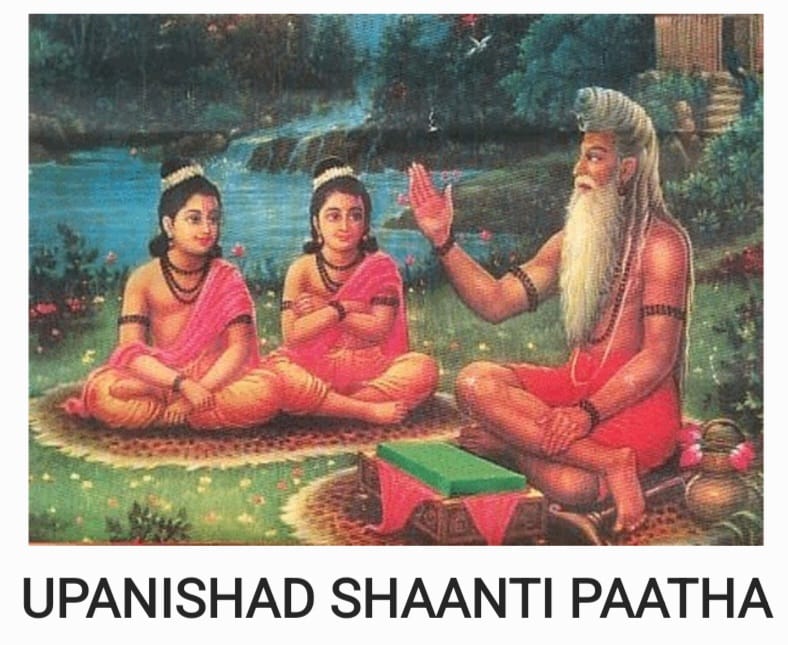
UPANISHAD SHAANTI PAATHA
ॐ श्री गुरुभ्यो नमः। ॐ श्री भवानिशङ्कराय नमः।
ॐ श्री मात्रे नमः।
JAI SHANKAR
From today I will take up what are popularly called Shaanti Mantraa-s. Every साधक/साधिका
chants a couple of these Mantra-s during his/her anushthaan and poojan.
There are these ten Peace Chants(PC) followed
by Maths owing allegiance to Acharya Shankara.
They are called शांकरमठसंप्रदायीयाः शान्तयः। These
PCs are apportioned between eleven main
Upanishads(श्वेताश्वतरोपनिषत् included). If we do not limit the PCs to Upanishads only, then they will be in hundreds because the Veda-s constitute a veritable storehouse of PCs indeed.
The primary PC is ॐ शान्तिः शान्तिः शान्तिः ॐ This PC has got to be the concluding chant, whatever other PC one may take.
What does this primary PC mean? ॐ stands for
Brahman(God – ॐ इति एकाक्षरं ब्रह्म says Gita). By
uttering ॐ, we say शान्ति thrice to ward off distressing (ताप) happenings on three(त्रय )fronts – happenings that rob us of peace. They are: आधिभौतिक -External. A flash strike by bus/cab drivers, garbage collectors, Municipal water supply cadres, power supply employees illustrates this distress. आध्यात्मिक – Internal. Illness of body and mind, the six ‘enemies’ (lust,anger,greed etc).
आधिदैविक – calamities beyond our control like famine, drought, floods, tsunami, earthquake, hurricane etc.
The number three also stands for three tenses of time(वर्तमान, भूत, भविष्य) and three states of consciousness (waking, dream, sleep). We pray for peace to pervade all these triads by warding off the three-fold distress(तापत्रय).
Says Swami Maheshvarananda Giriji Maharaj(MG) :
विघ्नाः सन्तापाश्च त्रिविधाः। तत्र ज्वर शिरोव्यथा कामक्रोधादयश्च
आध्यात्मिकाः। भूकम्प अतिवृष्टि अनावृष्टि इत्यादिरूपाः
आधिदैविकाः। सर्पवृश्चिकादिभूतकृता उपद्रवास्त आधिभौतिकाः।
एषां त्रयाणाम् उपशमनाय त्रिः शान्तिशब्दः पठ्यते। प्रणवेन
परमेश्वरानुस्मरणमपि निखिलविघ्नसन्तापोपशमनार्थं अत्र विधीयते।
This is self-explanatory being in simple Sanskrit.
UPANISHAD SHAANTI PAATHA
LET US NOW LISTEN TO THE VEDIC CHANTS BY THE REVERED SWAMIJIS OF RKM. IN THIS VIDEO WE HAVE SHANTI MANTRAAS UPTO 2.13 FOLLOWED BY MANTRA PUSHPANJALI AND AT THE END WE HAVE THE SHANTI MANTRA ॐ पूर्णमदः… ॐ
There is a verse which names the ten Upanishads:
ईशकेनकठप्रश्नमुण्डमाण्डूक्यतित्तिरिः।
ऐतरेयं च छान्दोग्यं बृहदारण्यकं दश।।
Another verse says about allocating PCs to different Upanishads:
वाक्पूर्णसहनाप्यायन्भद्रंकर्णेभिरेव च।
पञ्चशान्तीः पठित्वादौ पठेद्वाक्यान्यनन्तरम्।।
The assigned PCs should be chanted before commencing स्वाध्याय as also at the end of it. This verse gives us the beginning letters of the respective PCs. श्वेाश्वतरोपनिषत् doesn’t figure above. It is the 11th. It is most beautiful, in simple Sanskrit. There is an elaborate commentary on it by AS too. Some scholars dispute that AS has not written this भाष्य, but, it is written by some later-day namesake. We need not get into such quibbles. The भाष्य is illuminating. That’s enough for us.
Here is the allocation:
वाङ्मे मनसि शान्त्यैव त्वैतरेयं प्रपठ्यते।
ईशं पूर्णमदेनैव बृहदारण्यकं तथा।
सहनाविति शान्त्या च तैत्तिरीयं कठं च वै।
आप्यायन्त्विति शान्त्यैव केनछान्दोग्य संज्ञके।
भद्रं कर्णेभि मन्त्रेण प्रश्नमाण्डूक्यमुण्डकम्।
इति क्रमेण प्रत्येकमुपनिषद आदावन्ते च शान्तिं पठेत्।।
Aitareya Upanishad – वाङ्मे मनसि प्रतिष्ठिता….
Ishaavaasya and BrihadaaraNyaka – पूर्णमदः….
Taittiriya, KaTha, Shvetaashvatara – सहनाववतु…
Kena and Chaandogya – आप्यायन्तु ममाङ्गानि…
Prashna, MuNDaka,MaaNDookya – भद्रं कर्णेभिः…
We will explore the meaning of each of these
PCs in the coming days.
Peace (शान्ति), says revered Swami Ranganathanandaji, is our ‘constitutional necessity.’ Everyone longs for peace and strives for it by straight or devious means, be he a pauper or a prince, a sinner or a saint. In the Gita(2-66) the Lord says: One who has no peace, how can he be happy?(अशान्तस्य कुतः सुखम्?). Ironically nowadays wars are waged to bring about peace!.
Needless to say, therefore, a peaceful mileu is most indispensable for an Acharya and his pupils in a Gurukul. How can स्वाध्याय take place effectively if the teacher and the taught are mentally disturbed and/or there is noise
all around? So, the PC(Peace Chant) is both the prefix and the suffix of स्वाध्याय .
1. ॐ वाङ्मे मनसि प्रतिष्ठिता मनो मे वाचि प्रतिष्ठितम्, आविराविर्म एधि वेदस्य च आणीस्थः, श्रुतं मे मा प्रहासीः, अनेन अधीतेन अहोरात्रान् संदधामि, ऋतं वदिष्यामि सत्यं वदिष्यामि, तन्मामवतु तद्वक्तारमवतु अवतु माम् अवतु वक्तारम् अवतु वक्तारम्।
ॐ शान्तिः शान्तिः शान्तिः ॐ
This is the PC(Peace Chant, शान्ति मन्त्र) for Aitareya Upanishad.
1. Translation of AS by Revered Swami
Gambhiranandaji (of RKM) is as follows:
“May my speech be based on(I.e. in accord with) the mind; may my mind be based on speech. O Self-Effulgent One, reveal Thyself to me. May you both(speech and mind) be the carriers of Veda to me. May not all that I have heard, depart from me. I shall join together (i.e.obliterate the diffefence of) day and night through this study.
I shall utter what is verbally true (ऋतम्). I shall utter what is mentally true (सत्यम्). May That
(Brahman) protect me; may That protect the
speaker(Teacher). May That protect me; may That protect the speaker, may That protect the
speaker”.
NOTE: What a beautiful portrait of a Vedic student of the good old days is here! The FIRST
prayer is for consistency between thought and
speech. A noble soul, says a सुभाषित, is one who has consistency in thought, speech and deed. An ignoble soul is the very reverse(मनस्येकं वचस्येकं कर्मण्येकं महात्मनाम्। मनस्यन्यत् वचस्यन्यत् कर्मण्यन्यत्
दुरात्मनाम्।।). The SECOND prayer is for Brahman(God) to manifest His Grace and ensure that both the mind and speech become the carriers of Vedic lore. The THIRD prayer is for मेधा, retentive power. There was not there the luxury of notebooks. Everything was heard(Shruti) and retained in mind. So, the student prays that what was heard should not be forgotten. During Thread Ceremony there is a rite called मेधाजनन and Goddess Saraswati is invoked to bless the Vatu ( a Vedic student in Gurukul in the past ) with robust retentive power(मेधा शक्ति).(मेधां मे देवी सरस्वती आदधातु).
The FOURTH is a vow, a commitment that he will study day and night. The FIFTH is again a pledge that he will bear witness to both सत्य (truth) and ऋत (Right). We are all enjoined upon to speak truth(सत्यं ब्रूयात्), but how? प्रियं ब्रूयात् – say it sweetly, in the right way(ऋतं). God forbid, the truth may be unpleasant(like death, disaster etc) and so, we should cautiously reveal it to the affected person. This is ऋतं, the art of telling truth in as nice a way as possible to avert shock and damage.(painless surgery ). The SIXTH prayer, last but not the least, is for God to take care of both, the Guru and the Shishya. Protection for the Guru is prayed for twice whereas it is only once for the Shishya – This shows how concerned the Shishya is about his Guru! If one Shishya is sick, the Gurukul will go on; but, God forbid, if the Guru is sick, the Ashram will grind to a halt!
2. ॐ पूर्णमदः पूर्णमिदं पूर्णात्पूर्णमुदच्यते। पूर्णस्य पूर्णमादाय पूर्णमेवावशिष्यते।। ॐ शान्तिः शान्तिः शान्तिः ॐ (PC for ईशावास्य उपनिषद् and बृहदारण्यक उपनिषद्).
2. AS says: Om. That (Supreme Brahman) is
infinite and this(conditioned Brahman) is
infinite. The infinite (conditioned Brahman)
proceeds from the infinite(Supreme Brahman).
(Then, through knowledge), taking the
infinite of the infinite(conditioned Brahman),
it remains as the infinite (unconditioned Brahman) alone. Om Peace! Peace! Peace!
(Translation by Pujya Swami Gambhiranandaji).
NOTE: This is the Peace Chant(PC) for two
Upanishads – Ishaavaasya and BrihadaaraNyaka.
To a lay reader, above explanation doby AS, is a hard nut to crack. Swami MG(Maheshwarananda Giriji) says: NirguNa Brahman(Supreme Brahman) is KaaraNa Brahman and the Creation before us is Kaarya Brahman(SaguNa, conditioned Brahman). The intrinsic property of Cause inheres in the Effect. (पूर्णात् कारणात्मनः परमेश्वरात् कार्यं पूर्णंमेव उद्गच्छति। यद्यपि तत् परमार्थस्वरूपादन्यदिव प्रत्यवभासते, तथापि यत् स्वस्वरूपभूतं परमात्मभावलक्षणं पूर्णत्वं तत् कदापि न जहाति।). The Supreme NirguNa Brahman , the Cause, is satchidaananda and it inheres in the Effect, the Creation consisting of animate and inanimate(जीव and जड). Here, the
equation, the similitude between Cause and
Effect is QUALITATIVE, not QUANTITATIVE.
Pujya Swami Somanathanandji of RKM in his
excellent treatise in Kannada called Upanishad Bhaavadhaare (ಉಪನಿಷದ್ ಭಾವಧಾರೆ) explains lucidly with Upanishadic examples the import
of this PC. The property of the ocean and its
wave is same (H2o). The property of gold and its ornaments is same. The property of clay and the pottery is same. Like God, we are PoorNa, not quantitati vely – we are not omnipresent and all pervasive like Him nor do we sport shankha, chakra, gadaa and padma – but, qualitatively.
we are like Him Sachchidananda. Like Him we are प्रेमस्वरूप, शान्तिस्वरूप, आनन्दस्वरूप etc. None can deprive us of this legacy except ourselves,
fooled by अविद्या (ignorance). Our Sadgurus strive to motivate us to claim this legacy, so did
Vedaanta Kesari(Lion of Vedaanta) Poojya Swami Vivekanandaji.
With the dawn of Self-Realisation, when every vestige of desire is blotted out and one is filled with seamless contentment, he exclaims like Santa Tukaram: संसार उडाला संदेह फिटला। पूर्ण तोचि झाला तुका म्हणे। He exclaims with Samarth Ramdas: त्या ब्रह्मबोधे ब्रह्मचि झाला। संसार खेद तो उडाला। He sees fullness everywhere like one standing in the middle of a lake seeing water everywhere.
मागे पुढे विठ्ठल भरला। रिता ठाव नाहीं उरला। This is the mystical अनुभूति (experience) of this Peace Chant. आनन्दी आनन्दगडे इकडे तिकडे चोहिकडे!
3. ॐ सह नाववतु। सह नौ भुनक्तु।
सह वीर्यं करवावहै।
तेजस्वि नावधीतमस्तु मा विद्विषावहै।।
ॐ शान्तिः शान्तिः शान्तिः ॐ
(PC for श्वेाताश्वतरोपनिषत् and कठोपनिषद्)
3. AS says: May He protect us both(the teacher and the taught) together(by revealing knowledge). May He protect us both (by
vouchsafing the results of knowledge). May we attain vigour together. Let what we study be
invigorating. May we not cavil at each other.
Om Peace! Peace!Peace! Om.
(Trs by Poojya Swami Gambhiranandaji of RKM).
NOTE: Revered Shri MG explains: The word नौ stands for the Teacher and the Taught, the
Speaker and the Listener. The disciple envisaged here is one who is endowed with the urge for knowledge as a result of performance of sacred work like Yajna, Charity and austerity in this and earlier lives; who has developed inwardness and one-pointedness as a result of उपासना practised as prescribed in the scriptures; who has come to the resolute conviction out of वैराग्य that the worlds (स्वर्ग etc) obtained from performance of desirous rites(काम्य कर्म) are trivial and essenceless; that the path of rituals cannot yield मोक्ष; who, therefore, approaches a Guru formally to seek Knowledge which confers Liberation.
(अत्र नौ इति शब्देन शिष्याचार्यौ श्रोता वक्तारावुच्येते। अस्मिन् जन्मनि अतीत जन्मसु वा अनुष्ठितैः यज्ञदानादिशुभकर्मभिरुत्पन्नविविदिषः; शास्त्रप्रोक्तैः उपासनैः अन्तर्मुख एकाग्रचित्तः; काम्यकर्मादिभिः सम्पादितानां लोकानाम् असारत्वं परीक्ष्य ततो निर्विण्णः, कर्मणा मोक्षो नास्तीति निश्चित्य मुक्तिहेतुब्रह्मतत्वज्ञानार्थं गुरूपसत्तिं यः करोति तादृशो अत्र शिष्यो विवक्षितः।).
The Guru is one well-versed in Vedic lore, very competent to teach by virtue of imbibing the true import of Veda-s and scriptures, who is rooted in Brahman and, therefore, devoid of outward bent of mind.
(गुरुश्च श्रोत्रियो वेदशास्त्रार्थपारङ्गततया बोधयितुं कुशलो
ब्रह्मनिष्ठत्वेन बहिर्मुखत्वरहितो विवक्षितः।).
The शिष्य prays for the welfare of both.(शिष्यः तयोः उभयोः क्षेमं प्रार्थयते). May that Brahman, graciously taught by the Guru, protect us both by revealing the light of Knowledge.
(यद् ब्रह्म आचार्यप्रसादानन्तरं मया वेदिष्यते, तद् ब्रह्म आवां उभौ सह अवतु विद्यास्वरूपप्रकाशेन रक्षतु पालयतु।).
The Guru, not lazy, should teach and I, the शिष्य, should imbibe his teaching without being unable to know or misunderstand – this is the protection prayed for
(यथा गुरुः निरालस्यः सन्नुपदिशेद्, यथा चाहम् उपदिष्टम् अर्थं अप्रतिपत्ति विप्रतिपत्तिरहितः सन् गृह्णीयाम् तथा रक्षणम् उपदेशसमये प्रार्थ्यते।).
May the knowledge obtained be vigourous I.e.capable of true revelation of the meaning.(आवाभ्यां यदधीतं तत् तेजस्वि वीर्यवत् स्वार्थप्रकाशकमस्तु). May we not be inimical towards each other (परस्परं द्वेषं मा करवावहै). The Shishya should not be dissatisfied that the Guru has not given his best and the Guru should not be dissatisfied that the Shishya has not served him well or listened attentively. May there not be this two-fold dissatisfaction.
(गुरुणा न सम्यग् व्याख्यातम् इति शिष्यस्य अपरितोषो द्वेषः, तथा शिष्येण शुश्रूषा न समीचीना कृता इति गुरोः अपरितोषो द्वेषः, तदुभयं मा भूदित्यर्थः।).
For warding off such dissatisfaction and displeasure, this PC(peace chant) is offered.(एवम् इतरेतर द्वेषशमनाय इयं प्रार्थना।).
4. शं नो मित्रः शं वरुणः शं नो भवत्वर्यमा। शं न इन्द्रो बृहस्पतिः।
शं नो विष्णुः उरुक्रमः। नमो ब्रह्मणे नमस्ते वायो त्वमेव प्रत्यक्षं ब्रह्मासि। त्वामेव प्रत्यक्षं ब्रह्म वदिष्यामि। ऋतं वदिष्यामि।
सत्यं वदिष्यामि। तन्मामवतु तद्वक्तारमवतु। अवतु माम् अवतु वक्तारम्। ॐ शान्तिः शान्तिः शान्तिः ॐ
(PC in Taittiriya Upanishad).
4. May Mitra be blissful to us. May VaruNa be
blissful to us. May Aryaman be blissful to us.
May Indra and Brihaspati be blissful to us. May VishNu of long strides be blissful to us.
Salutation to Brahman. Salutation to you, O Vaayu. You, indeed, are the immediate Brahman.
You alone I shall call as the direct Brahman.
I shall call you Righteousness. I shall call you
Truth. May He protect me. May He protect the teacher. May He protect me. May He protect the teacher. Om Peace! Peace!Peace!
(Trs by Poojya Swami Gambhiranandaji).
AS EXPLAINS: May Mitra, the deity who identifies himself with प्राण (inhalation) and day,become blissful. May, too, VaruNa, the deity who identifies himself with अपान(exhalation) and night, be blissful. Aryaman identifies himself with the eye and the sun, Indra with strength, and Brihaspati with speech and intellect. VishNu is उरुक्रम, possessed of great strides and identifies himself with the feet. Since the comprehension, retention and communication of knowledge of Brahman can proceed without hindrance when the gods are benevolent, their benignity is being prayed for. Vaayu, (air, life) is prayed to, because the fruits of our actions are in his keeping. Ritam, righteousness, is an idea, fully ascertained by the intellect in accordance with the scriptures and in conformity with practice. Satyam, Truth, is that which is reduced to practice by speech and bodily action.
(Trs by Poojya Swami Gambhiranandaji).
NOTE: Above reference to ऋतं and सत्य also means: May my speech be in conformity with ऋत and सत्य (righteousness and truth)..
Mitra means friend. God is our eternal friend (सखा त्वमेव). One of the twelve names of Sun is Mitra. Sun is the universal friend. He gives his light to all alike. VaruNa means most worthy of being sought after by devotees(भक्तजन वरणीयः). God is Aryamaa because He supervises ऋत (justice, righteousness, न्याय). Law of Karma operates under Him. He is also the head of Manes(पितृ), our departed ancestors.
The Lord says in Gitaa: पितृणामर्यमा चास्मि(10-29).
God is Indra because He is the remote control of all our senses(इन्द्रिय-s). Brihat means big, He is the biggest of all, Brihaspati.
He is देवदेव, महादेव.
5. आप्यायन्तु ममाङ्गानि वाक् प्राणश्चक्षुः श्रोत्रमथो बलमिन्द्रियाणि च सर्वाणि, सर्वं ब्रह्मोपनिषदं, माऽहं ब्रह्म निराकुर्यां मा मा ब्रह्म निराकरोदनिराकरणमस्तु अनिराकरणं मेऽस्तु । तदात्मनि निरते य उपनिषत्सु धर्माः ते मयि सन्तु ते मयि सन्तु।
(This is the PC for Kena and Chhandogya Upanishads).
5. May my limbs, speech, vital force, eyes, ears, as also strength and all the organs, become well developed. Everything is Brahman as revealed in the Upanishads. May I not deny Brahman; may not Brahman deny me. Let there be no spurning (of me by Brahman). Let there be no rejection( of Brahman) by me. May all the virtues spoken of in the Upanishads repose in me, who am engaged in the pursuit the Self. May those virtues repose in me.
NOTE: A sound mind in a sound body is the ideal for all and is a must for a spiritual aspirant. The MuNDaka Upanishad says: “The Self cannot be realised by the weak.”
(नायमात्मा बलहीनेन लभ्यः).
Our body is the first requisite to pursue Dharma(शरीरमाद्यं खलु धर्मसाधनम्). Good health is at the root of our fruitful pursuit of the four पुरुषार्थ-s (धर्मार्थकाममोक्षाणाम् आरोग्यं मूलमुत्तमम्). Hence, the above prayer. Says Shri MG : “Let my limbs, organs etc develop well so as to be
propitious for my Brahma Dhyaana (मम सर्वाणि
इन्द्रियाणि प्राणपञ्चकं च ब्रह्मध्यानानुकूलतया वृद्धिं प्राप्नुवन्तु ).
The rejection of the Brahman is twofold – to think that there is something else beside Brahman or to think there is no such entity called Brahman(ब्रह्मातिरिक्तं वस्त्वस्ति इति
वा ब्रह्म नास्तीति वा मिथ्याभावनया माहं ब्रह्म निराकुर्यां
तिरस्कुर्यां). The rejection by Brahman means “Let not Brahman separate me from Him and hurl me into संसार”(मा ब्रह्म स्वस्मान्मां वियोजयतु संसारे मा पातयतु इति यावत्). The repetition ते मयि सन्तु ते मयि सन्तु (let those Upanishadic virtues be in me) is to highlight their importance(आदरार्था द्विरुक्तिः).
At a College in Chennai many decades ago, Pujya Swami Vivekanandaji saw the students weak and listless. He told them: “Be strong, my young friends; that is my advice to you. YOU WILL BE NEARER TO HEAVEN THROUGH FOOTBALL THAN THROUGH THE STUDY OF GITA…….YOU WILL UNDERSTAND THE GITA BETTER WITH YOUR BICEPS, YOUR MUSCLES, A LITTLE STRONGER”.(Complete Works 3-242).
6. ॐ भद्रं कर्णेभिः शृणुयाम देवाः, भद्रं पश्येमाक्षभिर्यजत्राः।
स्थिरैरङ्गैः तुष्टुवांसस्तनूभिः, व्यशेम देवहितं यदायुः।।
स्वस्ति न इन्द्रो वृद्धश्रवाः, स्वस्ति नः पूषा विश्ववेदाः।
स्वस्ति नस्तार्क्ष्यो अरिष्टनेमिः, स्वस्ति नो बृहस्पतिर्दधातु।।
ॐ शान्तिः शान्तिः शान्तिः ॐ
(These are PCs for Prashna, MuNDaka and
MaaNDookya Upanishads).
6. Om! O gods, may we hear auspicious words with our ears; While engaged in sacrifices, may we see auspicious things with our eyes; While praising the gods with steady limbs, may we enjoy a life that is beneficial to the gods.
May Indra of ancient fame be auspicious to us;
May the supremely rich(or all-knowing) Pusha
(god of the earth) be propitious to us; May
GaruDa, the destroyer of evil, be well disposed towards us; May Brihaspati ensure our welfare.
Om! Peace! Peace!Peace!
(Trs by Poojya Swami Gambhiranandaji of RKM.
NOTE: Shri MG says: व्यशेम देवहितं यदायुः can mean: 1. O gods,with your grace, may we spend a long span of life, free from ill-health and such other defects (युष्मत् प्रसादतः नीरोगत्वादि गुणविशिष्टं चिरजीवित्वं प्राप्नुयाम।).
2. May we spend the lifespan, say 116 years, ordained by Brahmaa(देवेन प्रजापतिना व्यवस्थापितं यदायुः षोडशाधिकशतप्रमाणं तद् व्यशेम।).
3. May we spend a lifespan that is very fit and propitious for worship of God.(देवहितं देवोपासनायोग्यम् आयुः जीवनं व्यशेम।).
6. स्वस्ति न इन्द्रो वृद्धश्रवाः etc
(Contd from yesterday)
Shri MG annotates:
Svasti (स्वस्ति): Competence to listen to Veda and Upanishads, reflect upon them and hold on to the conviction(अहं ब्रह्मास्मि) steadfastly. Svasti also means the resultant bliss of Self-Realisation (स्वस्ति वेदोपनिषदध्ययनश्रवणमनननिदिध्यासनानुष्ठानार्थं क्षेमं शोभनं सामर्थ्यं, तत्फलं परिपूर्णब्रह्मानन्दं च।).
Indra is chief of gods I.e.God Himself.
(इन्द्रः देवपतिः परमात्मा )
Vriddhashravaa (वृद्धश्रवाः) means: of great fame
(बृहत्कीर्तिः). Exceeding, expanding fame and success (वृद्धं बृहत् विस्तीर्णं प्रभूतं श्रवः यशो वा यस्य).
Pooshaa (पूषा): The Sun, fosterer of the universe
(विश्वपोषकः सूर्यः).
Vishvavedaa (विश्ववेदा): Knows the entire universe
(विश्वं सर्वं जगत् वेत्ति जानाति). He is All-knowing (सर्वज्ञः
सर्ववित्).
Taarkshyo Arishtanemi (तार्क्ष्यो अरिष्टनेमि): GaruDa.
He has unimpeded movement(अरिष्टा अकुण्ठिता
अप्रतिबद्धा नेमिः गतिः यस्य). The metallic axle of the wooden wheel ensures its safety. Likewise,
GaruDa wards off all sorts of obstructions caused by sorrow etc and takes care of the devotee who has come to him( यथा काष्ठमयस्य चक्रस्य लोहमयी नेमिः तद्भङ्गाभावं पालयति एवमयं तार्क्ष्यः सर्वविधां दु:खदोषादिप्रयुक्तां रिष्टां प्रतिहतिं विनिवार्य स्वोपसन्नं भक्तं सर्वदा पालयतीति यावत्।).
Brihaspati: Custodian of the vast Veda-s
(बृहतां वेदानां पालयिता वेदाचार्यः).
May God, with all such excellences(signified by names like Indra etc), bestow upon us
welfare(svasti) – this is the prayer.
7. यश्छन्दसामृषभो विश्वरूपः।
छन्दोभ्योऽध्यमृतात् संबभूव।
सं मेन्द्रो मेधया स्पृणोतु।
अमृतस्य देव धारणो भूयासम्।
शरीरं मे विचर्षणम्।
जिल्हा मे मधुमत्तमा।
कर्णाभ्यां भूरि विश्रुवम्।
ब्रम्हणः कोशोऽसि मेधया पिहितः।
श्रुतं मे गोपाय।।
ॐ शान्तिः शान्तिः शान्तिः ॐ
(This PC is in Taittiriya Upanishad 1-4-1).
7. Om is the most exalted in the Vedaa-s. It pervades all words. It emerged from the
immortal Veda-s as their quintessence. May
he(Om that is Indra), the Supreme Lord, gratify me with intelligence. O Lord, may I be the
receptacle of immortality. May my body be fit;
May my tongue be surpassingly sweet; May I hear much through the ears. You are the sheath of Brahman; You are covered by (worldly) wisdom; Protect what I have heard.
(Trs by Poojya Swami Gambhiranandaji).
NOTE: Bull(ऋषभः) signifies here greatness. Om
towers above all Vedic metres(Chhandas). It
pervades the world. Shri MG says: The world is two-fold: objects signified by words and the
words themselves (स च प्रणवो विश्वरूपः सर्वजगदात्मकः। द्विविधो हि विश्वप्रपञ्चः – अर्थप्रपञ्चः शब्दप्रपञ्चश्च।). Om is both.
So many things, indispensable for a student in the Gurukula, are prayed for here. They are
the dire need of our students today too. Body
should be fit. Tongue should be sweet(जिह्वायाः
मधुत्वं सत्यहितमितप्रियभाषित्वलक्षणम् – truthful, salutary,
of few words and pleasant).
Let me hear a lot(विद्योत्पादकं बहुविधग्रन्थजातम्).Let all my senses and limbs be in fine fettle, fit for aspiring for knowledge of the Self(आत्मज्ञानयोग्यः
सकलोऽयं कार्यकरणसंघातोऽस्तु इति).
Om is praised here as the sheath(कोश) of Brahman. As the leathery sheath protects the sword, so does Om the Brahman I.e. it is the
support for meditation on Brahman.(यथा चर्ममयः
कोशः खड्गरक्षणाय आलम्बनभूतः तद्वद् ब्रह्मध्यानरक्षणाय
प्रणवः आलम्बनभूतः).
May You protect what I have heard.(कर्णाभ्याम्
अवगतं वेदार्थरहस्यविज्ञानादिकं मे गोपाय – please keep intact what I have imbibed through my ears – the quintessential teachings of Veda-s). Pray ward off defects like forgetfulness and thus enable me to know the Veda-s(विस्मृत्यादिदोषान् निवार्य तत्प्राप्तिलाभेन पालय). He, who is desirous of augmenting his intellectual vigour, should do जप of these prayers(जपार्था एते मन्त्राः मेधाशक्तिकामस्य).
8. अहं वृक्षस्य रेरिवा, कीर्तिः पृष्ठं गिरेरिव,
ऊर्ध्वपवित्रो वाजिनीव स्वमृतमस्मि,
द्रविणं सवर्चसम्, सुमेधा अमृतोक्षितः,
इति त्रिषङ्कोः वेदानुवचनम्।।
ॐ शान्तिः शान्तिः शान्तिः ॐ
8. I am the invigorator of the tree(of the world).
My fame is high like the ridge(पृष्ठम् )of a mountain. My source is the pure Brahman. I am like that pure reality(of the Self) that is in the sun(वाजिनी). I am the effulgent(सवर्चसम्) wealth(द्रविणम् ). I am possessed of a fine intellect(सुमेधा). I am immortal and undecaying(अमृतोक्षित:). This was the statement of Trishanku after the attainment of realisation.(1-10-1 of Taittiriya Upanishad)
(Trs by Poojya Swami Gambhiranandaji of RKM)
AS says this Mantra is for जप and this जप is conducive to Self-Knowledge.
NOTE: Trishanku has shed his जीवभाव – limited
identity with body-consciousness. Now, he is one with Brahman, hence his sublime outburst.
The tree, if understood as creation, I am its
invigorator. If the tree is taken as संसार, then I am its cutter(री हिंसायाम्). Trishanku symbolises the साधक. During जप, he prays: may I, the seeker of मोक्ष, be capable of chopping down the Ashvatta tree of संसार with the axe of dispassion and detachment(मुमुक्षुरहं संसाररूपस्य अश्वत्थवृक्षस्य रेरिवा विषयवैराग्यरूपेण असङ्गशस्त्रेण च्छेत्ता भूयासम्।). I am very pure(ऊर्ध्वम् उत्कृष्टा पवित्रं विशुद्धिः यस्य मम,सोऽहमूर्ध्व पवित्रोऽस्मि।). वाज् means movement. Sun is ever on the move (वाज: गतिः, तद्वान् आदित्यो वाजी, स हि सर्वदा वेगेनैव गच्छति). For a wealthy person, gems and jewels constitute his wealth. But, for a Knower of Brahman, Self-Realisation is the resplendant wealth.(धनिकस्य रत्नादि धनमस्ति, ब्रह्मविदस्तु विज्ञातमात्मतत्वमेव द्रविणं धनं सवर्चसम्).
The जप of this PC(peace chant) wards off debility and dullness of intellect(अस्य शान्तिमन्त्रस्य जपः प्रज्ञामान्द्यादिदोषनिवारणद्वारा विद्याप्रकाशको भवतीत्यवगम्यते।)
9. यो ब्रह्माणं विदधाति पूर्वं,
यो वै वेदांश्च प्रहिणोति तस्मै।
तं ह देवम् आत्मबुद्धिप्रकाशं,
मुमुक्षुर्वै शरणमहं प्रपद्ये।।
ॐ शान्तिः शान्तिः शान्तिः ॐ
(PC for श्वेाश्वतरोपनिषत्).
9. He, who creates Brahmaa at first and then
forwards to Him the Veda-s, to Him, God, the
illuminer of one’s intellect, I, the seeker of
Moksha, surrender.
10. भद्रं नो अपि वातय मनः। (RgVeda 1-20-1) ॐ शान्तिः शान्तिः शान्तिः ॐ
10. O Lord, please ensure good, auspicious thoughts, come to my mind.
Shri MG says:
हे परमेश्वर! नः अस्माकं त्वत्प्रसादाद् भद्रम्
अभ्युदय नि:श्रेयसलक्षणं कल्याणम् अस्तु।
तथा तदर्थं अस्माकं मनः त्वं कृपया
अपिवातय भद्रविचारयुक्तं कृत्वा पावनं
विघ्नविक्षेप रहितं प्रसन्नं शान्तम् एकाग्रं च विधेहि इति प्रार्थना।
(O God, by Your grace, may we be blessed with both material and spiritual welfare!
For that sake, pray endow my mind with good thoughts so that it is rendered pure, free from
obstructions like distractions, cheerful, serene and one-pointed. This is the prayer.)
THESE TEN ARE CALLED SHAANTI-S ACCEPTED
BY MATHS OWING ALLEGIANCE TO ACHARYA SHANKARA(शाङ्करमठ संप्रदायीयाः शान्तयः).
NOTE: Shri MG means Late HH Swami Maheshwarananda Giriji Mahamandaleshwar,
Kankhal, Haridwar. Ref: His Rigveda Samhitopanishad Shatakam.
8. अहं वृक्षस्य रेरिवा, कीर्तिः पृष्ठं गिरेरिव,
ऊर्ध्वपवित्रो वाजिनीव स्वमृतमस्मि,
द्रविणं सवर्चसम्, सुमेधा अमृतोक्षितः,
इति त्रिषङ्कोः वेदानुवचनम्।।
ॐ शान्तिः शान्तिः शान्तिः ॐ
8. I am the invigorator of the tree(of the world).
My fame is high like the ridge(पृष्ठम् )of a mountain. My source is the pure Brahman. I am like that pure reality(of the Self) that is in the sun(वाजिनी). I am the effulgent(सवर्चसम्) wealth(द्रविणम् ). I am possessed of a fine intellect(सुमेधा). I am immortal and undecaying(अमृतोक्षित:). This was the statement of Trishanku after the attainment of realisation.(1-10-1 of Taittiriya Upanishad)
(Trs by Poojya Swami Gambhiranandaji of RKM)
AS says this Mantra is for जप and this जप is conducive to Self-Knowledge.
NOTE: Trishanku has shed his जीवभाव – limited
identity with body-consciousness. Now, he is one with Brahman, hence his sublime outburst.
The tree, if understood as creation, I am its
invigorator. If the tree is taken as संसार, then I am its cutter(री हिंसायाम्). Trishanku symbolises the साधक. During जप, he prays: may I, the seeker of मोक्ष, be capable of chopping down the Ashvatta tree of संसार with the axe of dispassion and detachment(मुमुक्षुरहं संसाररूपस्य अश्वत्थवृक्षस्य रेरिवा विषयवैराग्यरूपेण असङ्गशस्त्रेण च्छेत्ता भूयासम्।). I am very pure(ऊर्ध्वम् उत्कृष्टा पवित्रं विशुद्धिः यस्य मम,सोऽहमूर्ध्व पवित्रोऽस्मि।). वाज् means movement. Sun is ever on the move (वाज: गतिः, तद्वान् आदित्यो वाजी, स हि सर्वदा वेगेनैव गच्छति). For a wealthy person, gems and jewels constitute his wealth. But, for a Knower of Brahman, Self-Realisation is the resplendant wealth.(धनिकस्य रत्नादि धनमस्ति, ब्रह्मविदस्तु विज्ञातमात्मतत्वमेव द्रविणं धनं सवर्चसम्).
The जप of this PC(peace chant) wards off debility and dullness of intellect(अस्य शान्तिमन्त्रस्य जपः प्रज्ञामान्द्यादिदोषनिवारणद्वारा विद्याप्रकाशको भवतीत्यवगम्यते।)
UPANISHAD SHAANTI PAATHA IS CONCLUDED, THERE ARE MANY VEDIC SHAANTI MANTRAAS – NOT LINKED TO ANY UPANISHADS -NOW WILL COVER SOME
VEDIC SHAANTI MANTRA-S
1. ॐ मधुवाता ऋतायते मधु क्षरन्ति सिन्धवः। माध्वीर्नः सन्त्वोषधीः।
मधु नक्तम् उतोषसी।
मधुमद् पार्थिवं रजः।
मधु द्यौरस्तु नः पिता।
मधुमान्नो वनस्पतिः।
मधुमान् अस्तु सूर्यः।
माध्वीर्गावो भवन्तु नः।
ॐ शान्तिः शान्तिः शान्तिः।
1. To us, who are the devotees of the Supreme Truth, let the wind blow sweetly. Let the rivers run sweetly. Let the herbs be to us sweet. Let there be sweetness during day and night. Let the dust of the earth exude sweetness. Let heaven, our father, be sweet to us. Let the fruit-bearing trees be sweet to us.,
Let the sun be sweet to us. Let the cows be sweet to us. AUM Peace! Peace! Peace!
This Mantra is in RgVeda(1-90) as well as in Shukla Yajurveda (13-27-29). It is used during स्नान with honey in पञ्चामृत अभिषेक. On the day of marriage, after the ceremonial welcome to the bridegroom(idragaLsaNi in Konkani) at the venue, he(the Prince Charming ) is seated and offered मधुपर्कं and one of the Mantra-s Bhatmam chants is this Mantra. It is a prayer for his wedded life to be a tale of everlasting sweetness.
2. ॐ द्यौ शान्तिः अन्तरिक्षं शान्तिः
पृथिवी शान्तिः
आपः शान्तिः
ओषधयः शान्तिः
वनस्पतयः शान्तिः
विश्वे देवा: शान्तिः
ब्रह्म शान्तिः
सर्वं शान्तिः शान्तिरेव शान्तिः
सा मा शान्तिरेधि।।
(शुक्ल यजुर्वेद 36-17)
2. Peace be in the sky, peace in the mid-region,
peace on earth, peace in the waters, peace in the herbs and the trees, peace from all gods
(and goddesses), peace from God Almighty,
peace everywhere and in everything, peace from peace, may that peace come to me.
What a comprehensive prayer for global peace!
Environmental Awareness – the buzzword
bandied about breezily nowadays, came naturally to our Vedic ancestors.
This Mantra used to be chanted during जलारति
in our Shiva Pujan.
NOW LET US LISTEN TO A FEW VEDIC CHANTS BY THE REVERED MONKS OF RKM.