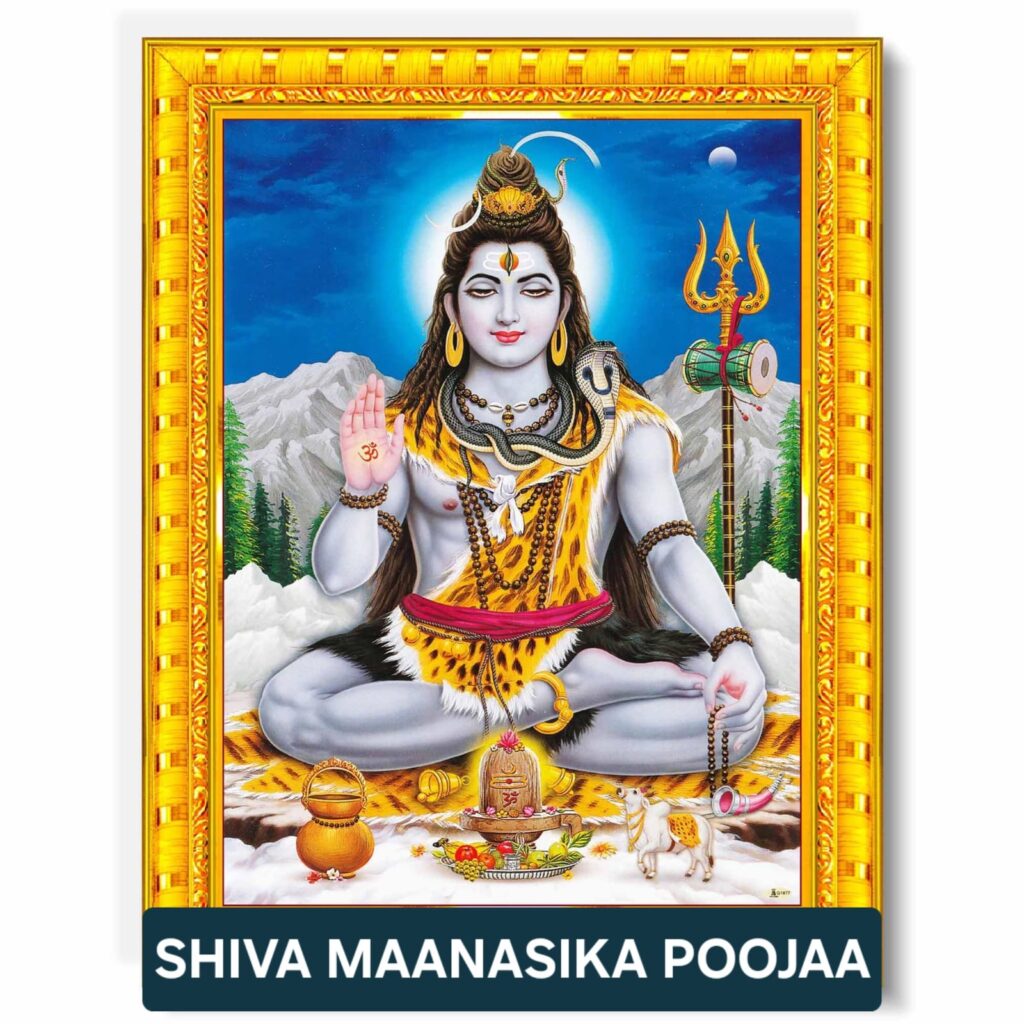
SHIVA MANASIKA POOJA
ॐ श्री गुरुभ्यो नमः। ॐ श्री भवानिशङ्कराय नमः।
ॐ श्री मात्रे नमः।
JAI SHANKAR
This is a hymn by the renowned saint and savant of Tamilnadu, Shri Sadashiva Brahmendra. He was a mystic of a very high order . He is also refered to as an Avadhoota. He is known for many Kriti-s (Compositions) in Sanskrit, set to many राग -s of Carnatic music. During the course of this series we will listen to a couple of Kriti-s.
He was born in a hamlet called Thiruvisanallur in 1630 A.D. and merged in the Almighty in 1755 A.D. at a place called Nerur where His समाधि still stands. His Vedantic treatise is आत्मविद्या विलास in Sanskrit. Of His many कृति-s set to Carnatic राग-s, only about 24 have survived. ब्रूहि मुकुन्दे ते रसने,
भज रे गोपालम्, पिबरे रामरसं रसने are some of them.
We can listen to them on YouTube. His Guru was
Shri Paramashivendra.
He calls this hymn शिवमानसिक पूजा and not शिवमानस पूजा as does AS. Both,, however, mean the same.
SHIVA MANASIKA POOJA
1. अनुचितमनुलपितं मे त्वयि ननु शम्भो तदागसः शान्त्यै। अर्चां कथमपि विहिताम् अङ्गीकुरु सर्वमङ्गलोपेत ।।1।।
1. O Shambho, I may have uttered inappropriate words about You. To atone for that sin, somehow (कथमपि) I have performed Your worship. Pray accept it, O Thou, endowed with all auspiciousness!
God is called Shambhu because, as we have seen in our earlier series, He brings about(bhaavayati) universal welfare(शम्).
Sarvamangalopeta also means ‘who is with Paarvati, the abode of auspiciousness’. One of Her names is सर्वमङ्गला.
The word ‘somehow’ (कथमपि) is meant to highlight our utter inabilty to adore the Infinite with our finite mind.
2. ध्यायामि कथमिव त्वां धीवर्त्म विदूर दिव्य महिमानम्।
आवाहनं विभोस्ते देवाग्र्य भवेत् कुतः स्थानात्।।2।।
2. Somehow, I will meditate on Thee, whose divine glory is afar from the way of intellect. O Vibho, foremost among the gods, from which spot shall I invoke Thee?
Shiva is all-pervasive. It means He is already present here. So, how can I pray to Him ‘to please come in'( आवाहनम्)?
God is called Vibhu because He has Himself
become(भवति) the manifold(वि, vividha) of names and forms(नामरूप).
कियदासनं प्रकल्प्यं कृतासनस्येह सर्वतोपि शिव।
पाद्यं कुतोऽर्घ्यमपि वाऽपाद्यं सर्वत्र पाणि पादस्य।।3।।
3. O Shiva, which seat shall I provide Thee, who are seated here and everywhere? How can I offer Thee water to wash the Feet) and arghya(a respectful offering into the hand) when Thy feet and hands are everywhere?
God is called Shiva, the ever-serene. He is always at peace, hence called Sadaashiva. We, too, can be in peace always and everywhere by communing with Him. His Name is the Password to Peace.
4. आचमनं ते स्यादपि भगवन् भव सर्वतोमुखस्य कथम्।
मधुपर्को वा कथमिह मधुवैरिणि दर्शित प्रसादस्य।।4।।
4. Thou hast Thy faces on all sides, so, O Bhava,
O Bhagavan, how can there be Aachamana(ritual sipping of water)
for Thee? How also can Madhuparka be offered to Thee, who art gracious to the enemy of Madhu(demon)(मधु वैरिणि), VishNu?
Shiva is the origin of life(भव). Among AshTamoorti-s He represents water(ॐ भवाय
जलमूर्तये नमः) and water is the symbol of life.
God is endowed with six fortunes(bhaga), hence He is Bhagavaan(ऐश्वर्यस्य समग्रस्य वीर्यस्य यशसः श्रियः। ज्ञान वैराग्ययोश्चैव षण्णां भग इतीरणा।।).
Madhu is honey. It is also the name of a demon killed by VishNu. So, the poet-saint wonders how Madhu can be offered when VishNu(the recipient of Shiva’s grace) killed Madhu! A bit of rhetorical flourish here, playing on the dual meaning of Madhu.
Madhuparka is a respectful offering to God and an important guest. It is also prescribed as an offering to the bridegroom upon his first arrival at his father-in-law’s house. It has five ingredients – curd, ghee,water, honey and sugar(दधि सर्पिः जलं क्षौद्रं सिता चैतश्च पञ्चभिः प्रोच्यते मधुपर्कं:).
5. स्नानेन किं विधेयं सलिलकृतेनेह नित्य शुद्धस्य।
वास्त्रेणापि न कार्यं देवाधिपते दिगम्बरस्येह।।5।।
5. Thou art eternally pure. Hence, of what avail is bath offered to Thee with water(सलिलेन)? O Lord of gods, of what avail is the offering of cloth too, Thou being clothed by all the directions(दिक् अम्बर)?
6. स्फुरति हि सर्पाभरणं सर्वाङ्गे सर्वमङ्गलाकार।
अतिवर्णाश्रमिणस्तेऽस्त्युपवीतेनेह कः स्विदुत्कर्षः।।6।।
6. O Embodiment of Auspiciousness, the serpent-ornament is glistening all over Thee(सर्वाङ्गे) as Thy ornament(so, what ornament can I offer Thee?). Thou hast transcended VarNa(braahmaNa, kshatriya, vaishya, shoodra) and the Aashramaas(brahmachaari, grihasta, vaanaprastha, sanyaasa), so in what way will the sacred thread(जान्वे in KonkaNi) enhance (utkarsha) Thy glory?
Sarvamangalaakaara also means अर्धनारीश्वर, पार्वती(सर्वमङ्गला) being part of His form(आकार).
7. गन्धवती हि तनुस्ते गन्धा: किं नेश पौनरुक्त्याय।
पुष्कर फलदातारं पुष्कर कुसुमेन पूजये किं त्वाम्।।7।।
O Lord(ईश), Thy body itself is fragrant
(गंधवती). So, of what avail is the repetition
of offering Thee fragrance?
Thou art a liberal dispenser of ‘fruits'(pushkara phala-daataa)(fruits being our wishes). So, of what avail is my worship of Thee with lotus flowers(pushkara kusuma)? In Sanskrit grammar there is a saying रलयोरभेद: which means र and ल are non-different and interchangeable. So, the first pushkara is actually pushkala(abundant). The poet-saint plays pun on the word पुष्कर.
शमधनमूलधन त्वं सकलेश्वर भवसि धूपितः केन।
दीपः कथं शिखावान् दीप्येत पुरः स्वयं प्रकाशस्य।।8।।
8. O Lord of all, Thou art the
capital wealth(moola-dhana) of those whose
wealth(dhana) is serenity(शम )of mind.
By which incense can I propitiate Thee?
Thou art self-luminous. By which flaming(shikhaavaan) lamp, can Thou be illumined?
In Shiva-poojan, we say: धूपमाघ्रापयामि त्वां
दशांगं गुग्गुलान्वितम्।(I will make Thee inhale this incense, composed of ingredients like
guggulu and dashaanga(Ayurvedic herbs).
The inhalation is supposed to calm and soothe the mind of the inhaler. But, Shiva is already serene and is the inspiration for the
ascetics whose wealth is शम (serenity).
So, the poet-saint wonders how to offer this उपचार?
7. गन्धवती हि तनुस्ते गन्धा: किं नेश पौनरुक्त्याय।
पुष्कर फलदातारं पुष्कर कुसुमेन पूजये किं त्वाम्।।7।।
O Lord(ईश), Thy body itself is fragrant
(गंधवती). So, of what avail is the repetition
of offering Thee fragrance?
Thou art a liberal dispenser of ‘fruits'(pushkara phala-daataa)(fruits being our wishes). So, of what avail is my worship of Thee with lotus flowers(pushkara kusuma)? In Sanskrit grammar there is a saying रलयोरभेद: which means र and ल are non-different and interchangeable. So, the first pushkara is actually pushkala(abundant). The poet-saint plays pun on the word पुष्कर.
8. शमधनमूलधन त्वं सकलेश्वर भवसि धूपितः केन।
दीपः कथं शिखावान् दीप्येत पुरः स्वयं प्रकाशस्य।।8।।
8. O Lord of all, Thou art the
capital wealth(moola-dhana) of those whose
wealth(dhana) is serenity(शम )of mind.
By which incense can I propitiate Thee?
Thou art self-luminous. By which flaming(shikhaavaan) lamp, can Thou be illumined?
In Shiva-poojan, we say: धूपमाघ्रापयामि त्वां
दशांगं गुग्गुलान्वितम्।(I will make Thee inhale this incense, composed of ingredients like
guggulu and dashaanga(Ayurvedic herbs).
The inhalation is supposed to calm and soothe the mind of the inhaler. But, Shiva is already serene and is the inspiration for the
ascetics whose wealth is शम (serenity).
So, the poet-saint wonders how to offer this उपचार?
9. अमृतात्मकमपि भगवन् अशनं किं नाम नित्य तृप्तस्य। त्वय्याम्रेडितमेतत् ताम्बूलं यदिह सुमुखरागेऽपि।।9।।
9. O Bhagavan, of what avail is my offering of
Naivedya, even if the food(अशनम्) be nectarine, since Thou art in perpetual contentment(नित्यतृप्त)? This offering of
ताम्बूल here(iha) is also superfluous since Thy lips are already reddish(राग). The word
सुमुख says Shiva always has a pleasant face.
उपहारी भूयात् इदमुमेश यन्मे विचेष्टित्मशेषम्।
नीराजयामि तमिमं नानात्मानं सहाखिलै: करणै:।।10।।
10. O Consort of Umaa, may all(अशेष) my actions(विचेष्टितम्) be my present(उपहार) to Thee. May I wave आरति (नीराजयामि) to Thee, present in a variety of forms(नानात्मानम्), with all my senses(अखिलै करणै:)(as the lighted नीलाञ्जन-s).
सुमनश्शेखर भव ते सुमनोऽ़न्जलिरेष को भवेत् शम्भो।
छत्रं द्युमन् द्युमूर्ध्नश्चामरमपि किं जितश्रमस्य तव।।11।।
11. O Bhava, O Shambho, O Supreme (शेखर) God(सुमनस्), of what avail is this offering of flowers(सुमन) to Thee with folded hands(anjali)? Of what use is the umbrella, O Shining(द्युमन्) Shiva, since the sky(dyu) overhead (मूर्ध्न) serves as Thy umbrella? Of what use, too, is the chowrie(चामर) when Thou hast conquered fatigue(जित श्रम)?
सुमनस् is a synonym for god, सुमन means also a flower. the poet-saint plays pun on this word. The hand-fan chowrie is meant to remove the
fatigue, but, fatigue is not in Shiva’s dictionary at all.
10. उपहारी भूयात् इदमुमेश यन्मे विचेष्टित्मशेषम्।
नीराजयामि तमिमं नानात्मानं सहाखिलै: करणै:।।10।।
10. O Consort of Umaa, may all(अशेष) my actions(विचेष्टितम्) be my present(उपहार) to Thee. May I wave आरति (नीराजयामि) to Thee, present in a variety of forms(नानात्मानम्), with all my senses(अखिलै करणै:) (as the lighted नीलाञ्जन-s).
11. सुमनश्शेखर भव ते सुमनोऽ़न्जलिरेष को भवेत् शम्भो।
छत्रं द्युमन् द्युमूर्ध्नश्चामरमपि किं जितश्रमस्य तव।।11।।
11. O Bhava, O Shambho, O Supreme (शेखर) God(सुमनस्), of what avail is this offering of flowers(सुमन) to Thee with folded hands(anjali)? Of what use is the umbrella, O Shining(द्युमन्) Shiva, since the sky(dyu) overhead (मूर्ध्न) serves as Thy umbrella? Of what use, too, is the chowrie(चामर) when Thou hast conquered fatigue(जित श्रम)?
सुमनस् is a synonym for god, सुमन means also a flower. the poet-saint plays pun on this word. The hand-fan chowrie is meant to remove the
fatigue, but, fatigue is not in Shiva’s dictionary at all.
12. नृत्यं प्रथतां कथमिव नाथ तवाग्रे महानटस्येह।
गीतं किं पुरवैरिन् गीतागम मूलदेशिकस्य पुरः।। 12।।
12. O Lord, Thou art a superb dancer(महानट).
Before Thee(तवाग्रे), how can I arrange(प्रथताम्)
a dance performance? Thou art the original Teacher(moola deshika) of Saama-Veda, the
musical lore. So, O Enemy of Tripura demons, what song is worthy to be sung before Thee?
वाद्यं डमरुभृतस्ते वादयितुं वा परेऽस्ति का शक्तिः।
अपरिच्छिन्नस्य भवेदखिलेश्वर कः प्रदक्षिणविधिस्ते।।13।।
13. O Wielder of Damaru, who is capable of playing an instrument before Thee? Thou art limitless(aparichhinna), so, O Lord of all,(अखिलेश्वर), how can प्रदक्षिणा-s be done for Thee?
स्युस्ते नमांसि कथमिव शङ्कर परितोऽपि विद्यमानस्य।
वाचामगोचरे त्वयि वाक्प्रसरो मे कथन्नु संभवतु।।14।।
14. O Shankara, how can there be salutations to Thee when Thou art present all around? Thou art beyond the reach of speech, so, how can I be talkative before Thee?
नित्यानन्दाय नमो निर्मलविज्ञानविग्रहाय नमः।
निरवधिकरुणाय नमो निरवधि विभवाय तेजसेऽस्तु नमः।। 15।।
15. Salutations to Thee, who art in perpetual bliss. Salutations to Thee, who art the Embodiment of Pure Consciousness. Salutations to Thee, whose compassion is limitless. Salutations to Thee, whose glory and splendour are seamless.
SHRI SADASHIVA BRAHMENDRA HAS COMPOSED MANY KRITI-S IN SIMPLE SANSKRIT.
THEY ARE SUNG IN CARNATIC MUSIC. HERE IS A KRITI – BROOHI MUKUNDETI RASANE – SUNG AS A MUSICAL TRIBUTE TO BHARATA RATNA SMT.M.S.SUBBULAKSHMI.
(O TONGUE, SAY MUKUNDA, KESHAVA, MADHAVA, GOVINDA).
सरसिज विपक्ष चूडः सगरतनू जन्मसुकृतमूर्धाऽसौ।
द्रक् कूलङ्कष करुणो दृष्टिपथे मेऽस्तु धवलिमा कोऽपि।।16।।
16. May His white radiance(dhavalimaa) always loom in my vision(दृष्टिपथे). Whose? Shiva’s. Shiva has the crescent moon(सरसिज विपक्ष) on His crown(चूड:) as also on His head(मूर्धा) the Gangaa who imparted merit(sukrita) to the children of the King Sagara(सगरतनूजन्म).From His eyes(drik) compassion pours down in a stream (koolankasha).
Lotus(सरसिज) does not bloom in moonlight.
So, moon is unfriendly(vipaksha) to it. Sun
makes the lotus bloom, so he is the kinsman
of the lotus(सरसिज बांधव).
Shiva is fair in complexion(कर्पूर गौर), hence the reference to whiteness(धवलिमा).
Sagara’s 60,000 children were reduced to ash due to a curse of sage Kapila. Bhagiratha’s astounding effort(prayatna) brought about the descent of Gangaa, at whose touch they
got redemption.
जगदाधार शरासं जगदुत्पादप्रवीण यन्तारम्।
जगदवन कर्मठशरं जगदुद्धारम् श्रयामि चित्सारम्।।17।।
17. I take refuge(shrayaami) in Shiva, the essence of Consciousness(chit saaram), who made VishNu, engaged (कर्मठ) in protecting (अवन) the world(जगत्) as His arrow(शरम्); who made Mt Meru, which is the pivot of the world(जगदाधार ) as His bow(शरासम्) and engaged Brahma, skilled(प्रवीण) in creating(उत्पाद) the world(jagat) as His charioteer(यन्तारम्).
Shiva did as above during His encounter with
the demons Tripuraasuraas.
कुवलयसहयुध्वगलैः कुलगिरिकूटस्थकुचभरार्धांङ्गैः।
कलुषविदूरैश्चेतः कवलितमेतत् कृपारसै कैश्च।।18।।
18. By a strange couple my mind has been swallowed! The couple whose neck competes with the blue lily, whose half body has bosom as heavy as a mountain, who is full of compassion and whose mind is far away from any pollution.
NOTE: The couple is Ardhanaareeshvara, half body being of Paarvati. Shiva’s neck is blue like the blue lily. कलुष means impurity. Can this divine couple be stained with any negative traits?
वसनवते करिकृत्त्या वासवते रजतशैलशिखरेण।
वलयवते भोगभृता वनितार्धाङ्गाय वस्तुनेऽस्तु नमः।।19।।
19. My salutations to Him, who has elephant-hide as clothing, who resides on a peak of the silvery mountain(कैलास), whose wrist-bands are serpents and whose half-body is of an woman(पार्वती).
सरसिज कुवलय जागर संवेशन जागरुक लोचनतः।
सकृदपि नाहं जाने सुरमितरं भाष्यकारमञ्जीरात्।।20।।
20. Even once I will not care to know any God other than Him, whose eyes keep vigil on the
blooming and the fading of the lotus and the lily and whose anklet has become the Commentator.
NOTE: Shiva has three eyes, two of whom are sun and the moon. Sun causes the lotus to bloom and the lily to fade. The moon causes lily to bloom and lotus to fade. Adi Shankaracharya is well-known as भाष्यकार. He is said here to be Shiva’s anklet come alive. AS is called भगवत्पाद. His mission was to lead mankind to the Feet of God(भगवान्). So there is a charm in associating AS with the anklet of Shiva.
आपाटलजटानामानीलच्छायकन्धरासीम्नाम्।
आपाण्डुविग्रहाणामाद्रुहिणं किङ्करा वयं महसाम्।।21।।
21. We are servants of that Splendour. Whose?
Whose matted locks remind us of the पाटल flowers in hue, whose neck reminds us of a dark rain-bearing cloud and whose body is whitish in complexion.
मुषित स्मरावलेपे मूनितनयायुर्वदान्यपदपद्मे ।
महर्षिः मनो रमतां मे महति दयापूरमेदुरापाङ्गे।।22।।
22. May my mind rejoice and revel in that Great
Splendour! Whose? He, who pricked the arrogance of Cupid(स्मर god of passion), whose Lotus Feet confered lengthened span of life to the son of the sage and whose side-glance drips with overflowing compassion.
NOTE: Markandeya was the son of sage Mrikandu and he got a fresh lease of life from Shiva and thus escaped premature death.
शर्मणि जगतां गिरिजा नर्मणि सप्रेमहृदयपरिपाके।
ब्रम्हणि विनमद् रक्षणकर्मणि तस्मिन् उदेतु भक्तिर्मे।।23।।
23. May devotion arise in me for that Brahman,
who gives happiness to the world, who is very pleasant and courteous towards Girijaa(Parvati,
Daughter of the mountain), whose heart is ripe with love and who is engaged in protecting the devout who bow to Him.
NOTE: Here Shiva is equated with the formless Brahman.
अस्मिन् अपि समये मम कण्ठच्छायाविधृतकालाभ्रवत्।
अस्तु पुरो वस्तु किमप्यर्धाङ्गेदारमुन्मिषन्निटिलम्।। 24।।
24. May that indefinable Entity appear before me even now. How is it(He)? Whose neck resembles the shade of a rain-bearing dark cloud; Whose half-body is occupied by His spouse and on whose forehead there is an eye that is open.
NOTE: ‘Even now'(अस्मिन् अपि समये) – these two words signify that God-Realization is here (इहैव) and now(अधुनैव). The word किमपि signifies our inability to define God as इदम् इत्थम् ( like this.)
जटिलाय मौलिभागे जलधरनीलाय कन्धराऽभोगे ।
धवलाय वपुषि निखिले धाम्ने स्यान्मामको नमोवाकः।। 25।।
25. May my words of praise be to that Splendour (धाम्ने), whose head-region is matted, whose neck has the hue of a dark rain-bearing cloud and whose form is all white!
26.Enough(अलम्) of those lesser deities whose hands hold no deer, for whom the bull is replaced by the horse(तुरङ्ग), whose head bears no Gangaa and who have not frustrated the antics of Cupid (मनोभव, mindborn i.e.काम्, passion).
NOTE: Compared to Shiva, all other deities are
minor to a staunch Shaivite. The इष्ट देव alone excels for the devotee.
कस्मै वच्मि दशां मे कस्येदृक् हृदयमस्ति शक्तिर्वा।
कस्य बलं चोद्धर्तुं क्लेशात् त्वामन्तरा दयासिन्धो।। 27।।
27. O Ocean of Compassion! To whom shall tell my plight? Who else has such a (tender)
heart or power? Who else except Thou has the strength to lift me up from my distress?
याचे ह्यनभिनवं ते चन्द्रकलोत्तंस किञ्चिदपि वस्तु।
मह्यं प्रदेहि भगवन् मदीयमेव स्वरूपानन्दम्।। 28।।
28. O Lord with the crescent moon as the crown!
I am not beseeching Thee to bestow on me anything new. Please give me, O Lord, my own
bliss, which is, verily, my own nature.
NOTE: This verse expresses an important axiomatic truth of वेदान्त. Peace, joy, love etc are my real, original nature. They are intrinsic to me
like coolness to water, burning power to fire, heat and light to sun, serenity to moon and fragrance to the flower (तोये शैत्यं दाहकत्वं च वह्नौ, तापो भानौ शीतभानौ प्रसादः। पुष्पे गन्धः …..). Alas, now they are masked by Avidyaa(ignorance). Like a mirror overlaid with dust(यथा आदर्शो मलेन) or a flame with smoke (धूमेनाव्रियते वह्नि – गीता) or water in a lake overlaid with moss, my svaroopa (स्वरूप) is overlaid with Ignorance. Anugraha of God and the Guru sets aside this veil of Ignorance and, lo, then I discover myself! My own आनन्द which appeared AS IF not there, looms back into my experience! It is a DISCOVERY, not an INVENTION. If it were latter, then it will be transient – यत् कृतकं तत् अनित्यम् asserts Vedaanta.
भगवन् बालतया वाऽभक्त्या वाऽप्यापदाकुलतया वा।
मोहाविष्टतया वा माऽस्तु च ते मनसि यदुरुक्तं मे।। 29।।
29. O Lord! If I have spoken inappropriately about Thee due to childishness, lack of devotion, distress due to hardships or a delusive state of mind – may not my such impious speech
linger in Thy mind.
NOTE: This is a beautiful prayer forgiveness –
क्षमायाचना।
यदि विश्वाधिकता ते यदि निगमागमपुराणयाथार्थ्यम्।
यदि वा भक्तेषु दया तदिह महेशाशु पूर्णकामः स्याम्।। 30।।
30. If Thou hast surpassed(transcended) the universe, if there is any truth in the Veda-s,
Tantra-s and PuraaN-s and if Thou hast mercy
for Thy devotees, then, may I be quickly content and fulfilled, O Great Lord!
NOTE: This is a unique prayer: Almighty God has to prove His credentials to the devotee or else lose His title to being Almighty!
इति श्रीमत् परमहंस परिव्राजकाचार्य श्री परम शिवेन्द्रार्य
पूज्यपादशिष्य श्री सदाशिवब्रम्हेन्द्रकृतिषु शिवमानसिकपूजा
सम्पूर्णा।।
SHIVA MAANASIKA POOJAA CONCLUDED
LET US CONCLUDE THIS STOTRA AND TAKE LEAVE OF P.P.SHRI SADASHIVA BRAHMENDRA JI BY LISTENING TO ONE OF HIS FAMOUS कृतिs – भजरे गोपालं मानस – SET TO CARNATIC RAAG HINDOLAM (Hindustani मालकोंस)(O MIND, SERVE GOPAL).