SHREE GANESHAASHTAKAM
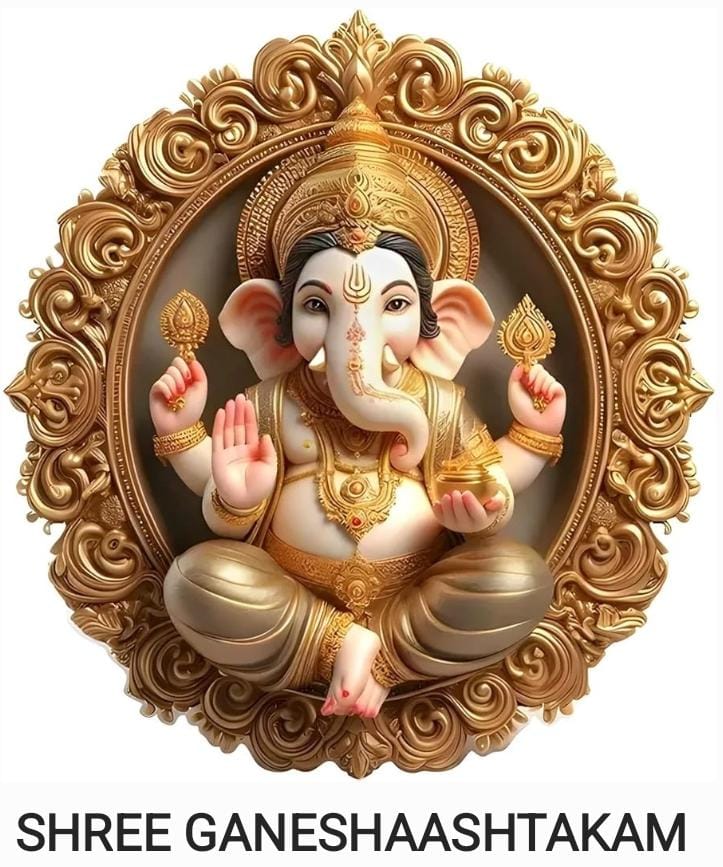
SHREE GANESHAASHTAKAM
JAI SHANKAR
There is a beautiful hymn to Shri GaNesha in the Upaasanaa KhanDa of GaNesha PuraaNa. It is ascribed to Shri Veda Vyaasa . It elaborates the Upanishadic teaching: “All this is, verily, Brahman”(सर्वं खलु इदं ब्रह्म). Every verse begins with “from whom”(यतो). The second
Brahma Sootra(1-1-2) reads “From whom the
origin etc of this”(जन्माद्यस्य यतः). The Taittiriya Upanishad uses यतः thus:
“यतो वा इमानि भूतानि जायन्ते, येन जातानि जीवन्ति, यत् प्रयन्त्यभिसंविशन्ति तद् विजिज्ञासस्व, तद् ब्रह्मेति।”
That from whom all these
beings take birth, by whom they live after birth,
that towards whom they move and into whom
they merge, know That. That is Brahman (3-1-1).
The word यतो is a favourite of the Upanishadic seers. यतो वाचो निवर्तन्ते अप्राप्य मनसा सह। (From whom the speech comes back baffled along with the mind)(Taittiriya Upanishad 3-9-1).
GANESHA is the same God whom we also invoke as Shiva, VishNu, Soorya or Devi in Her many forms because God is One. He is the Lord of several Groups(gaNa) that comprise creation. . Five cosmic elements, five vital breaths, five organs of perception, five motor organs, the quartet of mind, intellect, ego and चित्त (अन्तःकरण चतुष्टय) – all these clusters(गण) are His gifts. He is the monitor, the operator. So, He is GaNesha. He is also GuNesha – All that is good and gracious emanates from Him.
Veda-s describe Him as ‘poet among the poets’
(गणानां त्वा गणपतिं हवामहे कविं कवीनामुपमश्रवस्तमम्). God is poet par excellence. Then, where is His poetry? Veda says:
पश्य देवस्य काव्यं न ममार न जीर्यति
(Look at this creation. It is the poetry of God. It
never dies nor gets old) ( Atharva Veda 10-8-32).
Poetry abounds in nine sentiments (नव रस). Is not creation and our संसार geared to it, display all these रस-s? शृङ्गार हास्य करुण वीर रुद्र भयानक बीभत्स अद्भुत शान्त – all these are jostling in our day-to-day life!
SHREE GANESHAASHTAKAM
LET US LISTEN TO THIS SANSKRIT KRITI BY THE DOYEN OF CARNATIC COMPOSERS LATE SHRI MUTHUSWAMI DIXITAR – “महागणपतिं मनसा स्मरामि” IN RAAGA NATTAI, WHICH RESEMBLES OUR HINDUSTANI RAAG JOG(“साजन मोरे घर आये”).
यतोऽनन्तशक्तेरनन्ताश्च जीवा,
यतो निर्गुणादप्रमेयाद्गुणास्ते।
यतो भाति सर्वं त्रिधाभेदभिन्नं,
सदा तं गणेशं नमामो भजामः।।१।।
1. HE, from whom innumerable souls have emanated, who has infinite powers, who is
attributeless and immeasurable, but, is the
upholder of the guNa-s, from whom has
manifested all this creation marked by
three-fold difference, to Him, GaNesha, we bow down always and serve Him.
NOTE: As pointed out yesterday, every verse is full of यतो (from whom). The souls emanate from Him like sparks from a blazing fire
(यथा सुदीप्तात् पावकात् विस्फुलिङ्गाः, सहस्रशः प्रभवन्ते सरूपाः।
MuNDaka Upanishad 2-1-1).
He is beyond सत्व रजस् and तमस्, hence निर्गुण. But, Prakriti consisting of these गुण-s, is His शक्ति, His power. He is not amenable for measurement by our senses,speech, mind and intellect, so He is अप्रमेय. Remember the
analogy of Sri Ramakrishna: A salt doll set out to measure the depth of an ocean, but, lo, got dissolved in the process!
Not only the souls (जीव-s), but the entire creation has emanated from Him(यतो भाति सर्वम्). In the picturesque language of MuNDaka Upanishad: “As a spider spreads out and withdraws its thread, as on the earth grow the herbs (and the plants) and, as from a living person issue forth hair on the head(केश) and the body(लोमानि), so does the universe emanate from the Immutable
(यथोऽर्णनाभिः सृजते गृह्णते च,
यथा पृथिव्याम् ओषधयः संभवन्ति।
यथा सतः पुरुषात् केशलोमानि,
तथाऽक्षरात् संभवतीह विश्वम्।। 1-1-7.)
This creation is marked by three-fold भेद (difference): सजातीय – in one entity, say mango,
there are so many varieties. विजातीय – difference between a cow and a horse. स्वगत – in a tree we have trunk, branches, leaves, flowers, fruits etc.
यतो वह्निभानू भवो भूर्जलं च,
यतः सागराश्चन्द्रमा व्योम वायुः।
यतः स्थावरा जङ्गमा वृक्षसङ्घाः,
सदा तं गणेशं नमामो भजामः।।3।।
3. From whom have come into being the five cosmic elements, the sun, the moon, all moving and unmoving creation and hosts of trees – to
that GaNesha we bow down always and serve Him.
यतो दानवाः किन्नरा यक्षसङ्घाः,
यतश्चारणा वारणाः श्वापदाश्च।
यतः पक्षिकीटा यतो वीरुधश्च,
सदा तं गणेशं नमामो भजामः।।४।।
4. From whom have come into being demons and demigods like Kinnara, Yaksha and ChaaraNa and elephants, wild beasts, birds, insects and creepers – to that GaNesha we bow down always and serve Him.
यतो बुद्धिरज्ञाननाशो मुमुक्षो,
र्यतः सम्पदो भक्तसन्तोषदाः स्युः।
यतः विघ्ननाशो यतः कार्यसिद्धिः,
सदा तं गणेशं नमामो भजामः।।५।।
5.From whom comes (the gift of) Buddhi and the extinction of ignorance in the case of those asppiring for Moksha, from whom the devotees get wealth that gives contentment, who wards off obstacles and confers success in what we undertake to do – to that GaNesha we bow down always and serve Him.
NOTE: His gift is Buddhi, so we pray for it in our Gayatri. The awakened buddhi wipes out ignorance. Contentment is the true wealth and
a devotee is happy with whatever he has.
Many a time, obstacles(विघ्न) are of our own
making. We invite them by not employing God-given Buddhi. Proper application of Buddhi
also paves the way to success. When Buddhi
is perverse, we come to grief –
विनाशकाले विपरीत बुद्धिः।
Who gives us Buddhi? Shri GaNesha.
LET US LISTEN TO THIS INVOCATORY MANTRA
FOR SHRI GANESHA.
यतः पुत्रसंपद्यतो वाञ्छितार्थो,
यतोऽभक्तविघ्नास्तथानेकरूपाः।
यतः शोकमोहौ यतः काम एवं,
सदा तं गणेशं नमामो भजामः।।६।।
6. From whom one is blessed with the wealth called progeny and fulfilment of desires, want of devotion towards whom invites obstacles of all sorts, from whom arise grief, over-attachment and desire – to that GaNesha we bow down always and serve Him.
NOTE: The tiny mouse that Ganesha rides symbolises विघ्न(odds, obstacles). If a rat has sneaked into our home, there is no limit to the wanton destruction it will wreak!. Our valuable clothes, saris, documents – all will be torn. If,
however, we turn towards GaNesha(He is Dheesha, Lord of Dhi, I.e. बुद्धि ), He will awaken Buddhi in us and we will be able to
at least minimise the Vighna. HE neither gives
Vighna nor wards off Vighna directly. The
ultimate responsibility is ours – whether we choose to use Buddhi or not. In His Gita Bhaashya AS says: A person shivering in biting cold feels warmth if he goes near fire; the farther he goes away from fire, the more severe will be the cold. Is fire responsible for his plight?
शोक, मोह etc are vagaries of Prakriti – satva, rajas and tamas – and She is His shakti. Hence the ascription of these to GaNesha.
In the Gita(7- 12) the Lord says: Those states of mind that are saatvik, raajasik and taamasik – know them to have sprung from Me alone(मत्त एव इति तान् विद्धि). In 7-13 He says: This whole world is deluded by these three गुण-s(त्रिभिः गुणमयैः भावैः एभिः सर्वमिदं जगत्। मोहितम्….).
When we come across such texts we have to
ascribe them to Prakriti or माया which, in turn, is subservient to Him.
यतोऽनन्तभक्तिः सः शेषो बभूव,
धराधारणेऽनेकरूपे च शक्तः।
यतोऽनेकधा स्वर्गलोका हि नाना,
सदा तं गणेशं नमामो भजामः।।७।।
7. Due to unalloyed and overwhelming devotion to whom, the primordial Serpent Aadi Shesha could shoulder the burden of the earth with his
manifold forms, from whom have emanated many heavenly regions – to that GaNesha we
surrender and serve Him.
NOTE: According to the mythology, Aadi Shesha, the primordial Serpent, was a great devotee of VishNu. Pleased with his Bhakti, Shesha was assigned the formidable task of bearing the entire burden of the earth(धरा) upon his thousand hoods. How could Shesha perform such an onerous task? The strength came from God Himself. All those forces, too many to be counted, that ensure the earth doesn’t sink into a bottomless abyss, come from Him. The moral of the story: when God entrusts a responsibility to His Bhakta, He also imparts to him the necessary strength to perform. Acharya Shankara, Santa Jnaneshwar, Swami Vivekananda etc could condense in one brief life what others may take many many lives. Who gave them this strength? God Himself.
By associating Aadi Shesha with GaNesha in this verse, it is implied that God is One, call Him VishNu or GaNesha, it matters not.
यतो वेदवाचोऽतिकुण्ठा मनोभिः,
सदा नेति नेतीति यत् ताः गृणन्ति।
परब्रह्मरूपं चिदानन्दभूतं,
सदा तं गणेशं नमामो भजामः।।८।।
8. From whom comes the Vedic speech and about whom our minds get baffled and exclaim ‘not this, not this’, to that GaNesha, who is Supreme Brahman and Existence, Consciousness and Bliss, we surrender and serve Him.
NOTE: GOD is beyond the reach of our speech,
mind and intellect. In attempting to measure Him, they become blunted (कुण्ठित). Indeed, they owe their very being and strength to Him. So, how can they presume to map out and measure Him? Such foolhardy attempt is doomed to end miserably!
GANESHAASHTAKAM CONCLUDED
LET US LISTEN TO PANDIT ANAND BHATEJI PRESENTING THIS GANESHA SONG “OM NAMOJI AADYAA”.