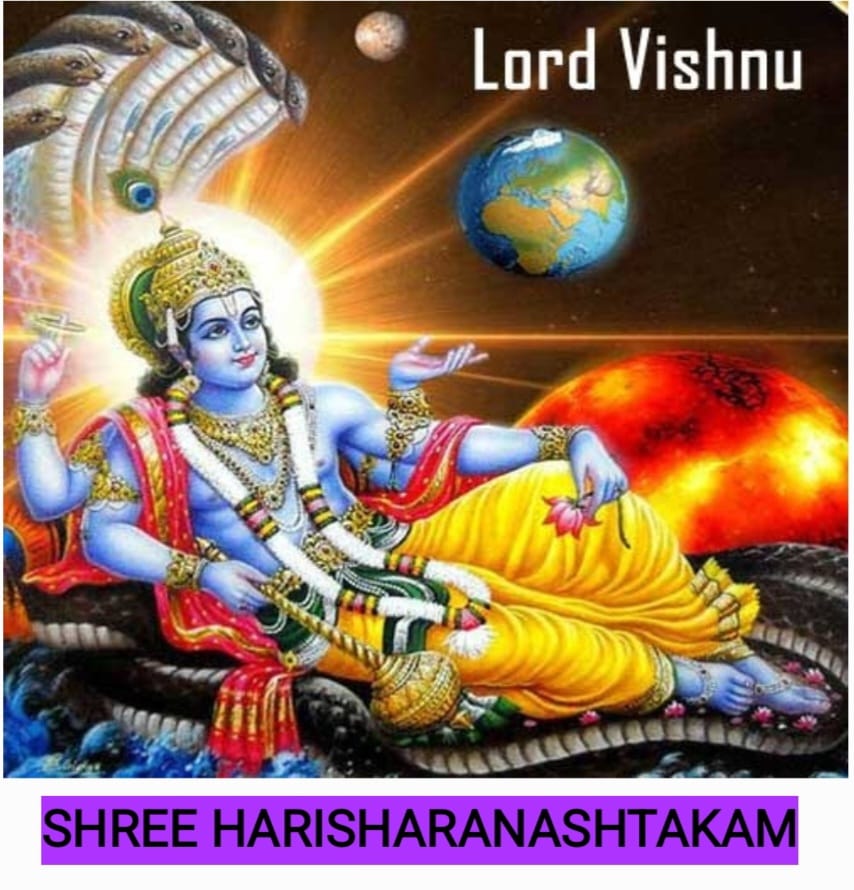
SHREE HARISHARANAASHTAKAM
SHREE MAHAAMANTRARAAJA STOTRAM
SHREE HARISHARANAASHTAKAM-1
ॐ श्री गुरुभ्यो नमः। ॐ श्री भवानिशङ्कराय नमः।
ॐ श्री मात्रे नमः।
JAI SHANKAR
This is a beautiful Ashtaka (eight verses) by late Swami
Brahmanandaji, whose Bhagavat SharaNa
Stotram has been covered in these columns earlier. HE had His Ashram at Pushkar near Ajmer. His Guru was Shrimat Mouktika Raamodaaseenaji. He wielded a prolific pen:
Apart from profound works in Sanskrit like VishNu Mahimna Stotra,Vichaara Deepaka, Yoga Rasaayanam and Brahmananda Moksha Gita, He composed several Ashtaka-s (अष्टक) named after Shankara, Raama, GaNesha,Hari and Veda Vyaasa.
These अष्टक-s are in our Stutimanjari. He has also composed a large number of Bhajans in Hindi and they are popular as Brahmananda Bhajanamaalaa. My annotations on the AshTaks on Raama and Shankara have appeared in these columns in February 2021 and can be accessed in the site
https:// bhanapcorner.in/
so graciously cared for by Shri Satish Kulkarni of Goregaon, Mumbai.
SHREE HARISHARANAASHTAKAM
LET US LISTEN TO THIS ASHTHAKAM.
ध्येयं वदन्ति शिवमेव हि केचिदन्ये,
शक्तिं गणेशमपरे तु दिवाकरं वै।
रूपैस्तु तैरपि विभासि यतस्त्वमेव,
तस्मात् त्वमेव शरणं मम शङ्खपाणे।।१।।
1. Some say only Shiva should be the object of our devotion. Others swear by Shakti(Devi),
GaNesha and the Sun. In all these forms it is You alone who shines variously. Therefore, to You alone is my surrender, O Wielder of the Conch!
NOTE: Millenia ago, the Veda-s proclaimed that Truth is One, but, is called variously by the wise(एकं सत् विप्राः बहुधा वदन्ति..). While we should have our Chosen Deity(इष्ट देवता), we should not belittle others’ favourites, but, as taught in the verse above, we should realise that God is One,
but, sports various names
(यो देवानां नामधा एक एव).
The इष्ट देव of revered saint Shri Ramavallabhadaas was KrishNa, but, He says in one song:
देव तो एक आहे, स्वामि तो एक आहे।
कोणि म्हणती गणेश,कोणि ध्याति रवीश।
कोणि म्हणति चंडीमाया..
कोणि म्हणति महादेव..
In our Shankara NaaraayaNa
Geeta, we pay our obeisance to all deities. When Hanuman, an Immortal, was asked why he was chanting रामनाम instead of KrishNa’s, as the prevailing Age was Dwaapara, his reply was classic:
श्रीनाथे जानकीनाथे अभेदो परमात्मनि।
तथापि मम सर्वस्वः रामो राजीवलोचनः।।
(I don’t differentiate or discriminate between the Consort of Shree and the Consort of Jaanaki as both are Paramaatman. However, my be-all and end-all is the Lotus-Eyed Raama!).
In the Stotra given in our Stutimanjari, in the last line of each verse we have मम दीनबन्धो. The version I am taking up has मम शङ्खपाणे. In the Bhagavat Sharanam Stotram we already had
मम दीनबन्धो.
Hari is having a conch always in His hand. The conch symbolises the call of the Veda-s(शङ्खः
वेदात्मकः, तं बिभर्ति इति शङ्खभृत्). The Wielder of
Conch(शङ्खभृत्) is name no. 993 in VishNu
Sahasranaama.
The conch in the hand of Hari is called
Paanchajanya. AS says it is symbolic of Cosmic Will that has given rise (janya) to five (पञ्च) elements. Shankha symbolises Shree, Lakshmi, Auspiciousness and hence its use on all auspicious occasions. It symbolises God, who bestows happiness(शम्) and has endowed us with the treasure of senses(खानि). Hence, Hari is always शङ्खपाणि – holding the conch in hand(पाणि).
It is said in Bhaagavatam that when the small boy, Dhruva,was in distress, VishNu touched his
throat with His conch and, lo, the child had
illumination and, at once, burst into a praise of the Lord! There are beautiful hymns ascribed to Dhruva in Bhaagavatam.
नो सोदरो न जनको जननी न जाया,
नैवात्मजो न च कुलं विपुलं बलं वा।
सन्दृश्यते न किल कोऽपि सहायको मे,
पस्मात् त्वमेव शरणं मम शङ्खपाणे।।२।।
2. My brother, father, mother,wife, son, my
family or clan and enormous strength(of various kinds) – none of these is seen to be of help to me. Therefore, to You alone is my surrender, O Wielder of Conch!
NOTE: All the relatives do help one during his earthly sojourn. Adore thy mother as God
(मातृ देवो भव), adore thy father as God (पितृ देवो भव) – these are the scriptural injunctions. The elder brother is held on par with father. In the Rudra Namakam, salutations are offered to brothers, elder as well as younger. Blessed is the state of a householder (धन्यो गृहस्थाश्रमः), runs a praise.
The wife is a partner in the practice of Dharma,
Hence she is सहधर्मचारिणी. So, it will be ungrateful and ungracious to dismiss them all as of no help.
Then, what is the meaning?
Yes, they all play a vital role in one’s mundane life. But, they can’t play proxy for one as regards Moksha. One can’t outsource Moksha!
We have to march to God in a single file.
During the Hindu marriage ceremony, the groom vows: धर्मे च अर्थे च कामे च न अतिचरामि – I will not be disloyal to her(bride) in my pursuit of these three Purushaartha-s, I will consult her, I will make her my partner. Please mark the conspicuous absence of the word मोक्ष in the vow. Why? The answer is simple: उद्धरेत् आत्मना आत्मानम् – one has to raise oneself by himself.
नोपासिता मदमपास्य मया महान्तः,
तीर्थानि चास्तिकधिया न हि सेवितानि।
देवार्चनं च विधिवन्न कृतं कदापि,
तस्मात् त्वमेव शरणं मम शङ्खपाणे।।३।।
3. Giving up arrogance, I did not serve noble,
godly souls. With firm faith in the existence of God, I did not resort to places of pilgrimage.
I didn’t perform worship in the prescribed manner. Therefore, to You alone is my surrender, O Wielder of the Conch!
NOTE: Where there is दम (restraint) there will be no मद – arrogance. When restraint is lacking, arrogance rears its head. Unless arrogance is given up, how can one bow down before Superiors in all humility? AS in His Upadesha Panchakam advises us:
गर्वः परित्यज्यताम् –
Give up pride. As said in Gita(16-15), the arrogant man brags:
आढ्योऽभिजनवानस्मि कोऽन्योऽस्ति सदृशो मया।
(I am rich and high-born; Who else is there like me?). The first line in the above verse says that सत्संग is to be cultivated in a mood of humility. In the words of Chaitanya Mahaprabhu, the साधक should feel humbler than a blade of grass and more forbearing than a tree
(तृणादपि सुनीचेन तरोरपि सहिष्णुना).
Satsang makes us detached (निस्संग) says AS (सत्सङ्गत्वे निस्सङ्गत्वम्).
The second line in the verse highlights the
importance of genuine faith in the existence of God – आस्तिक्यं बुद्धि. God longs for our भाव
(भावाचा भुकेला भगवन्त). As a Subhashita says: there are fish and many other acquatic creatures in Ganges. Do they get Moksha? They don’t have the godly gift of भाव.
Third line underscores the importance of Vidhi,
the prescribed mode and method of invocation,
offering the उपचार -s like आसन, पाद्य, अर्घ्य etc.
Our worship must not be whimsical and
haphazard. We use the KonkaNi word KaarNika (कार्णिक) while refering to certain temples: We aver that there is a potency, a special aura there, ensuring our prayers are answered. This कार्णिक does not depend on how huge and sprawling the temple is or whether the idol is of silver or gold. A Taantric verse says:
अर्चकस्य तपोयोगात् अर्चनस्यातिशायनात् आभिरूप्यात् च बिंबानां दैवसान्निध्यमृच्छति।
(The worshipper(if it is a temple, then the Priest) ।should be a practising साधक, observing the do’s and the don’ts. The procedure of worship should be strictly as prescribed (no compromise, no अनुकूल सिन्धु as our Parameshti Guru used to say jokingly) and the idol (the icon) should not be maimed, disfigured etc.). The stricter the
compliance with the three stipulations, the higher is the divine potency (कार्णिक) of the
shrine. Imagine , for example, a priest in a temple returns from a stroll in the market and enters the sanctum sanctorum (गर्भगृह) with his feet unwashed – thinking nobody is there to watch him – the कार्णिक, the potency of the shrine, will drain off in no time. I have given just an example. There can be many more polluting deviations from the norm. To replenish the deity’s dwindled कला, कलाभिवृद्धि होम -s are
performed. All these are subsidiary rites
integral to periodic Brahmakalashotsavs.
दुर्वासना मम सदा परिकर्षयन्ति,
चित्तं शरीरमपि रोगगणा दहन्ति।
मज्जीवनम् च परहस्तगतं सदैव,
तस्मात् त्वमेव शरणं मम शङ्खपाणे।।४।।
4. Unholy cravings are always pulling me away.
A host of ailments is scorching my mind as well as body . My life is now in others’ hands perpetually. Therefore, to You alone is my surrender, O Wielder of the Conch!
NOTE: This verse in my copy(2011 edition) of Stutimanjari has an error in the third line. Instead of मज्जीवनं, it is printed सञ्जीवनं. If this error is in your copy, please correct.
The first word in the first line is दुर्वासना. वासना or craving for good and godly experience is not
an evil. It is called सद्वासना. Samarth Ramdas says: Let your वासना be for Vaasudeva(मना वासना वासुदेवीं वसों दे). वासना for satsang, inspiring motivational books(like Swami Vivekananda literature), an intense desire to attend Kirtan etc is not evil, but, a facilitator. In His Bhaja Govindam hymn,
AS laments: “The body has become decrepit, the hair has turned grey, the mouth has become toothless and the old man totters about with a stick – even then, alas, the lump of desires goes not!
(अङ्गं गलितं पलितं मुण्डं दशनविहीनं जातं तुण्डम्।
वृद्धो याति गृहीत्वा दण्डं तदपि न मुञ्चति आशापिण्डम्).
The third line is illustrative of the pathetic condition of those who are at the mercy of others, who are utterly dependent on others
(परतंत्र). Manu, the ancient lawgiver, said long ago that dependence on others is sorrow and self-dependence is happiness
(सर्वं परवशं दुःखं सर्वमात्मवशं सुखम्।
एतद् विद्यात् समासेन लक्षणं सुखदुःखयोः).
पूर्वं कृतानि दुरितानि मया तु यानि,
स्मृत्वाखिलानि हृदयं परिकम्पते मे।
ख्याता च ते पतितपावनता तु यस्मात्,
तस्मात् त्वमेव शरणं मम शङ्खपाणे।।5।।
5. My heart shudders when I remember all the acts of indiscretion – errors of omission and
commission – committed by me in the past.
However, Your fame as a cleanser and
purifier of the fallen, is well-known. Hence,
to You alone is my surrender, O Wielder of the
Conch!
NOTE: There is this standing assurance of the Lord in Gita: “Even if a man of very bad conduct worships Me with one-pointed devotion, he is to be considered verily good; for he has resolved rightly. Quickly, he will turn righteous and attain
everlasting peace. O Son of Kunti, take it as My pledge: My devotee will not come to grief”.
(अपि चेत् सुदुराचारो भजते मामनन्यभाक्।
साधुरेव स मन्तव्यः सम्यग्व्यवसितो हि सः।।
क्षिप्रं भवति धर्मात्मा शश्वच्छान्तिं निगच्छति।
कौन्तेय प्रतिजानीहि न मे भक्तः प्रणश्यति।।) (9-30,31).
दुःखं जराजननजं विविधाश्च रोगाः,
काकश्वसूकरजनिर्निरये च पातः।
ते विस्मृतेः फलमिदं विततं हि लोके,
तस्मात् त्वमेव शरणं मम शङ्खपाणे।।६।।
6. Sorrow owing to birth, senility etc, various
diseases, birth in lower species like crow, pig etc and falling into hell – all this is the result of my utter failure to remember You. This fact is very well-known in the world. Therefore, to You alone is my surrender, O Wielder of the Conch!
NOTE: Santa Sohiroba pleads: हरिभजनावीण काल घालवूं नको रे(Please don’t while away your time without Hari-bhajan). Santa Jnaneshwar tells us in His Haripaatha: रिकामा अर्धघडी राहू नको(Don’t idle away even half-a-moment) and assures us: हरि उच्चारणीं अनंत पापराशी। जातील लयासी क्षणमात्रें। (With the chant of Hari’s names, limitless sins will come to naught)
नीचोऽपि पापवलितोऽपि विनिन्दितोऽपि।
ब्रूयात्तवाहमिति यस्तु किलैकवारम्।
तं यच्छसीश निजलोकमिति व्रतं ते,
तस्मात् त्वमेव शरणं मम शङ्खपाणे।।७।।
7. In the 2011 edition of Stutimanjari निन्दितोऽपि
should be corrected to विनिन्दितोऽपि to maintain the metrical balance.
Howsoever fallen, sinful and reviled by one and all, if he tells You just once “I am Yours”,
then, to him You are committed to bestow entry into Your personal abode( of VaikunTha) – this is Your vow. Therefore, to You alone is my surrender, O Wielder of the Conch!
NOTE: Here is a reference to the famous saying of Shri Raama to Sugreeva when the latter sounds alarm and cautions Him about giving asylum to VibheeshaNa. VibheeshaNa may be a spy, a stooge of RaavaNa – this is the doubt and fear of Sugreeva. Then, Sri Raama declares:
“If one surrenders and says just one ‘I am yours’ to Me, to him I will confer fearlessness from all – this is my Vow.”
(सकृदेव प्रपन्नाय तवास्मीति च याचते।
अभयं सर्वभूतेभ्यो ददाम्येतत् व्रतं मम।।).
वेदेषु धर्मवचनेषु तथागमेषु,
रामायणेऽपि च पुराणकदम्बके वा।
सर्वत्र सर्वविधिना गदितस्त्वमेव,
तस्मात् त्वमेव शरणं मम शङ्खपाणे।।८।।
8. In the Veda-s, Dharmashaastra, Aagama-s,
RaamaayaNa and the cluster of PuraaN-s,
everywhere You alone are spoken about in
various ways. Therefore, to You alone is my surrender, O Wielder of the Conch!
NOTE: There are four Veda-s: Rig, Yajus, Saama and Atharva. Manusmriti, Yaajnyavalkya Smriti,
Paraashara Smriti etc constitute Dharmashaastra. There are manuals setting forth in minute details worship of VishNu, Shiva, Devi etc – worship at home, in temples, temple layout and design, Rathotsava, periodic Brahmakalashotsavs etc etc – these are Aagama-s. We thus have VaishNava Aagama,
Shaiva Aagama, Shaakta Aagama etc. There are eighteen Mahaa (major) PuraaN-s and eighteen Upa PuraaNs(minor). All this mind-boggling literature sings praise of One God alone, manifesting as several इष्ट देव/देवता (Chosen Deity).
THIS STOTRA IS CONCLUDED
LET US LISTEN TO “HARI TUMA HARO JANAKI PIR”, A MEERA BHAJAN, SUNG BY BHARATA RATNA SMT. M.S.SUBBULAKSHM